
As organizations strive for higher scalability, drive user experience & align operations. The Salesforce Agentforce is emerging as the transformative AI-powered solution. The Agentforce solution represents how businesses utilize AI, with the Salesforce ecosystem, and redefine the processes. According to Salesforce’s State of Sales report, 83% of sales teams using AI saw revenue growth in the past year, compared to just 66% of teams without AI.
By leveraging Agentforce, organizations can experience a strategic roadmap that validates seamless integration by streamlining tools with business vision. It also offers early user engagement, expertise, and ongoing support for adoption. Frequent monitoring & optimization keep the system effective & scalable as the organizations evolve. This guide offers a complete brief of Salesforce Agentforce consulting service. It is helpful for the operational team, IT, and digital transformation.
What Is Agentforce and How It Works
Agentforce is the AI-powered solution that allows you to design and manage proactive agents for tasks throughout your organization. It operates on the Salesforce core platform, and supports sales, marketing & customer services. The AI agents offer 24/7 specialized support to employees & customers without human involvement. They use LLM to measure and understand interactions.
Businesses across the industries can benefit from the Salesforce Agentforce platform, which involves medical care, telecommunication & finance, retail, and tech. Agents can manage repetitive tasks effectively & accurately. It enables team members to focus more on strategic, complex initiatives.
To design an agent, you need to complete basic steps that involve defining the agent’s goal, describing the instructions, and setting guardrails. Salesforce Agentforce consulting services support businesses to take advantage of AI. With seamless integration & interface, you can easily create agents that work effectively & accurately. AI agentforce agents are revolutionizing service quality across industries by delivering faster & personalized customer interactions.
Why Decision Makers Need a Structured Agentforce Implementation
➔ Risks of unplanned or rushed implementation
An unplanned agentforce implementation leads to poorly defined workflows, low user adoption, and integration failure. Without complete planning, businesses risk data inconsistencies, safety gaps, & improved rework costs. These errors can delay value realization, hamper operation, and limit confidence among stakeholders to make valuable decisions.
➔ Importance of alignment with business objectives
Streamlining the Agentforce implementation with a clear organizational goal verifies that the solution directly supports strategic goals like customer efficiency, ROI, and efficiency. When AI agents are designed around the real-time business, business leaders can gain actionable insights, quick results, and measurable performance rather than disconnected automation with minimal impact.
➔ Long-term scalability and ROI considerations
The structured Salesforce Agentforce services allow a scalable architecture that can evolve with organizational demands & scalable growth. A well-designed structure enables simple expansion of AI agents, data sources, and integration. The future-proof foundation drives the long-term ROI by minimizing the technical debt, supporting frequent optimization, and ensuring sustained values.
Pre-Implementation Planning for Agentforce
⇒ Define Business Goals & Success Metrics
Clearly discuss your organizational vision & success metrics before you implement Agentforce services. Decision makers should identify specific errors AI agents must resolve. These errors might be enhancing response time, driving workflow automation & customer involvement. Establish measurable KPIs for productivity gain, cost reduction, accuracy & user adoption. The process verifies progress can be measured & results will be aligned based on your strategic goals.
⇒ Assess Existing Systems & Readiness
Measure existing system & organizational readiness support avoiding integration challenges during Agentforce implementation. It involves a review of the current CRM platform, quality of data, APIs, and security frameworks. Evaluation of team skills, governance, regulation & readiness verifies that the business can support AI-driven processes. Agentforce services allow smoother deployment, quick adoption, and limited operational risks.
Step-by-Step Agentforce Implementation Process
• Step 1: Requirement Discovery & Use Case Mapping
The Salesforce Agentforce implementation steps begin with detailed requirement discovery to understand business challenges, operational gaps, and stakeholder expectations. Teams collaborate to identify high-impact use cases where Agentforce can deliver measurable value, such as automating customer interactions or streamlining internal workflows. Clear documentation of functional, technical, and compliance requirements ensures AI agents are purpose-built, aligned with business objectives, and ready for seamless integration.
• Step 2: Architecture & Solution Design
In this Salesforce Agentforce implementation process, a robust Salesforce Agentforce architecture is designed to support performance, security, and scalability. This includes defining data flows, system integrations, agent orchestration, and governance models. Solution design focuses on reliability, future expansion, and compliance, ensuring the platform can adapt to evolving business needs while maintaining optimal efficiency and long-term ROI.
• Step 3: Agentforce Configuration & Development
Agentforce is configured depending on the defined organization demands & approved solution architecture. Automation rules, workflow, AI agents, data models & security roles are designed & customized to align with operational processes. The developers can verify scalability, compliance & performance optimization while managing clean configuration standards to support long-term maintenance and future upgrades.
• Step 4: Integration with Enterprise Systems
In the next phase, Agentforce is integrated with crucial enterprise systems like CRM, ERP, and marketing automation platforms. Businesses can also integrate this with data warehouse, 3rd-party applications. Secure APIs, middleware & real-time data synchronization are implemented to verify seamless information flow. The integration eliminates silos, drives operational visibility, and decision-making abilities. It allows a unified customer & organizational data ecosystem.
• Step 5: Testing & Validation
The comprehensive testing procedure verifies that the Agentforce solutions function as intended across scenarios. Under this phase, the experts perform integration testing, functional testing, performance & UAT testing for identifying and resolving the errors. Security checks and compliance validations are also performed. The structured validation limits deployment risk, verifies organization continuity, and builds stakeholder confidence prior to production.
• Step 6: Deployment & Go-Live
Throughout the deployment, Agentforce is migrated to the production environment following the structured release management. Data migration, configuration check, and system monitoring are the elements that need to be checked to ensure system stability. The end-user training & management support are provided to encourage adoption. Live monitoring and support offer a smooth transition, performance optimization & rapid issues resolutions.
Post-Implementation Optimisation
Post-implementation optimization of Salesforce Agentforce aims for regular performance improvement, user adoption, and evolving organization alignment. This phase covers monitoring KPIs, redefining the AI agent workflows, and optimizing the automation & integration. Frequent audits, feedback analysis & feature enhancements verify the platform remains scalable, effective, and aligned with changing business objectives.
Also Read: Salesforce Agentforce Features Every Decision Maker Must Know
Common Agentforce Implementation Challenges (and How to Avoid Them)
➨ Data quality issues
Data quality errors can significantly hamper the effectiveness of Agentforce by limiting the accuracy of automation, analytics & AI-driven recommendations. Outdated information, duplicate entries, inconsistent formatting & incomplete records lead to unreliable reporting & lack of trust. To avoid errors, conduct a comprehensive data audit before implementation, establish standardized data entry, and implement validation & deduplication tools. Ongoing monitoring & cleansing verify long-term data integrity.
➨ User adoption resistance
One of the most frequent causes is user adoption resistance. Workers may fear losing their jobs to automation, feel overburdened by new processes, or lack confidence in their ability to use the system efficiently. Strong executive sponsorship, open and honest benefit communication, role-based training initiatives, and ongoing support systems are all necessary to overcome this obstacle. Early key user involvement in the deployment process and frequent feedback collection promote engagement, foster trust, and promote long-term platform adoption.
➨ Integration complexity
User adoption resistance is among the most common factors. The assumed ROI isn’t opted for by Agentforce implementations. Employees may feel overwhelmed by new procedures, worry about losing their employment to automation, or lack confidence in their capacity to operate the system effectively.
To solve this challenge, strong executive sponsorship, transparent and honest benefit communication, role-based training programs, and continuous support systems are all required. Frequent feedback gathering and early key user participation in the deployment process encourage engagement, build confidence, and encourage long-term platform adoption.
➨ Governance and control gaps
Without governance, the Agentforce environment becomes tough to manage, leading to security errors, inconsistent configurations & uncontrolled customization. Lack of defined ownership & change management procedure may lead to performance errors. It can also cause compliance risks.
To avoid this, establish the governance framework with defined roles, access controls, approval workflows & compliance monitoring process. Frequent system audit, performance reviews & upgrades in policy support to maintain stability, safeguard crucial data & verify alignment with organization goals.
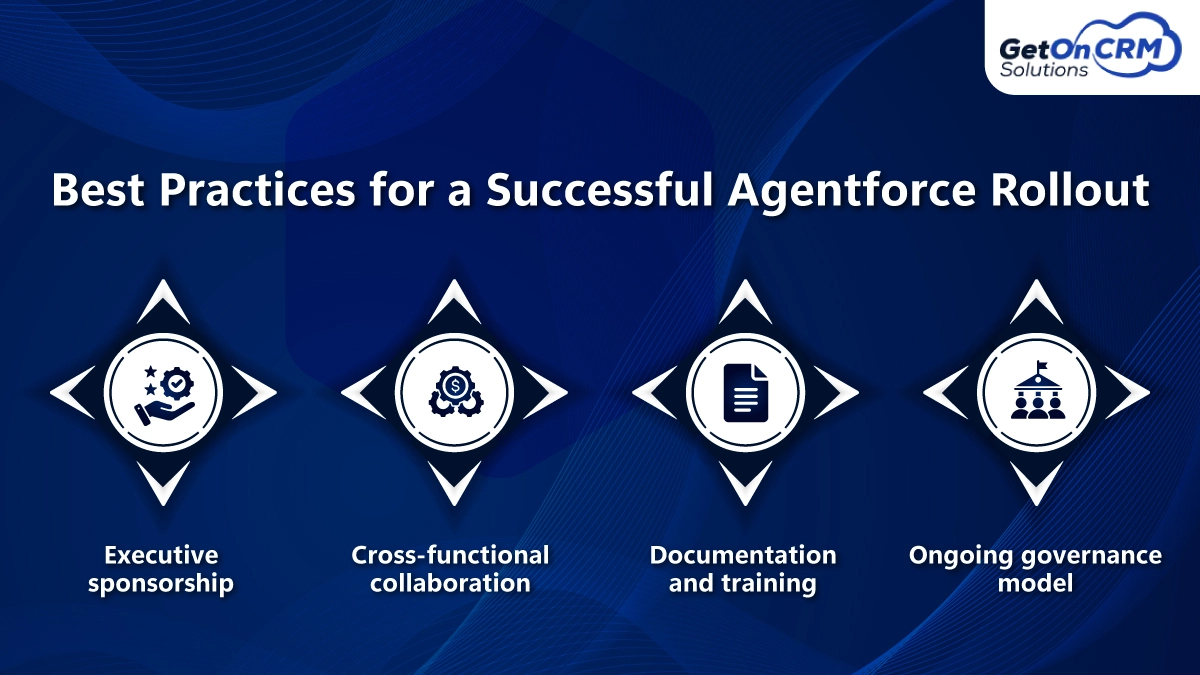
Best Practices for a Successful Agentforce Rollout
➥ Executive sponsorship
Strong executive sponsorship is necessary for the success of the Agentforce rollout. The leadership involvement verifies strategic alignment with organization goals, secures necessary budget & resources. It also reinforces the business commitment. When executives actively communicate the vision, expected outcomes & long-term values of Agentforce, it drives the confidence of stakeholders. The visible leadership supports decision-making and overcomes resistance throughout change management initiatives.
➥ Cross-functional collaboration
Sales, service, marketing, IT, and operations are among the departments that are impacted by the deployment of Agentforce. Cross-functional cooperation guarantees that processes are coordinated among teams and needs are precisely recorded. Rework is decreased, and solution design is enhanced when representatives from every department are included in the planning and testing stages. Shared KPIs, frequent workshops, and feedback loops promote accountability and guarantee that the platform provides quantifiable benefits to the entire company.
➥ Documentation and training
The comprehensive documentation & structured training programs are necessary for the long-term Agentforce success. The clear documents of workflows, integration logic, configuration & governance policies verify knowledge continuity and maintenance. The role-based training sessions and workshops support users to confidently opt for the platform. Regular learning & refresher sessions strengthen adoption, minimize errors, and exceed overall system utilization.
➥ Ongoing governance model
Agentforce implementation approach is kept safe, scalable, and in line with changing business requirements, thanks to a continuing governance model. Uncontrolled changes and technical debt can be avoided by establishing clear roles, approval procedures, release management guidelines, and compliance monitoring. System audits, KPI monitoring, and routine performance reviews all aid in finding areas for optimization. Platform stability is preserved while innovation and future improvements are encouraged via a well-organized governance system.
How to Measure Agentforce ROI
➢ Productivity gains
These metrics can be measured by tracking reduction in manual tasks, faster resolution time, enhanced lead response & improved output after implementation. Compare pre- and post-deployment performance metrics to measure improvements. Rate of automation usage, task completion speed & AI-assisted decision also offer clear indicators of workforce efficiency & overall operational demand.
➢ Cost savings
This factor can be evaluated by measuring limited operational expenses, lower support overhead, limited manual error & reliance on legacy systems. Agentforce automation can limit staffing strain & drive resource allocation. It is suggested to compare infrastructure, maintenance & process costs before and after implementation to calculate financial benefit & long-term ROI.
➢ Process efficiency improvements
Measure improvements in workflow automation rates, reduced bottlenecks, greater cross-departmental collaboration, and cycle time reductions to gauge process efficiency. Keep an eye on important metrics, including system response time, service resolution rates, and approval turnaround time. Agentforce also improves process consistency and operational agility through improved data visibility and simplified integrations.
➢ Customer and employee experience metrics
Measure experience improvements through customer satisfaction score, NPS, response time & better service consistency. Measure employee participation, adoption rates, duplication reduction, and system usability feedback. Positive trends in these indicators show that Agentforce is providing both internal teams and external customers with significant value.
Also Read: Top Salesforce Agentforce Implementation Partner Companies in the USA for 2026
Choosing the Right Agentforce Implementation Partner
➱ What decision makers should evaluate
When choosing an Agentforce implementation partner, decision makers should consider factors including client success stories, scalability capabilities, industry experience, and long-term support models.
➱ Technical expertise vs business understanding
An ideal Agentforce consulting partner aligns automation, AI capabilities, and integrations with quantifiable strategic goals by striking a balance between extensive technical Agentforce experience and a solid understanding of business processes.
➱ Security, compliance, and scalability experience
Assess the partner’s knowledge of data governance frameworks, enterprise security standards, regulatory compliance requirements, and creating scalable architectures that accommodate changing company needs and long-term growth.
Ready to Implement Agentforce with Confidence?
Agentforce is more than a tool. It’s an AI agent designed to drive productivity & decision-making. It blends Salesforce’s robust infrastructure with cutting-edge AI capabilities to automate complex workflows, offer smart solutions, & paralleled customer support. To future-proof your organization, hire Salesforce Agentforce services.