
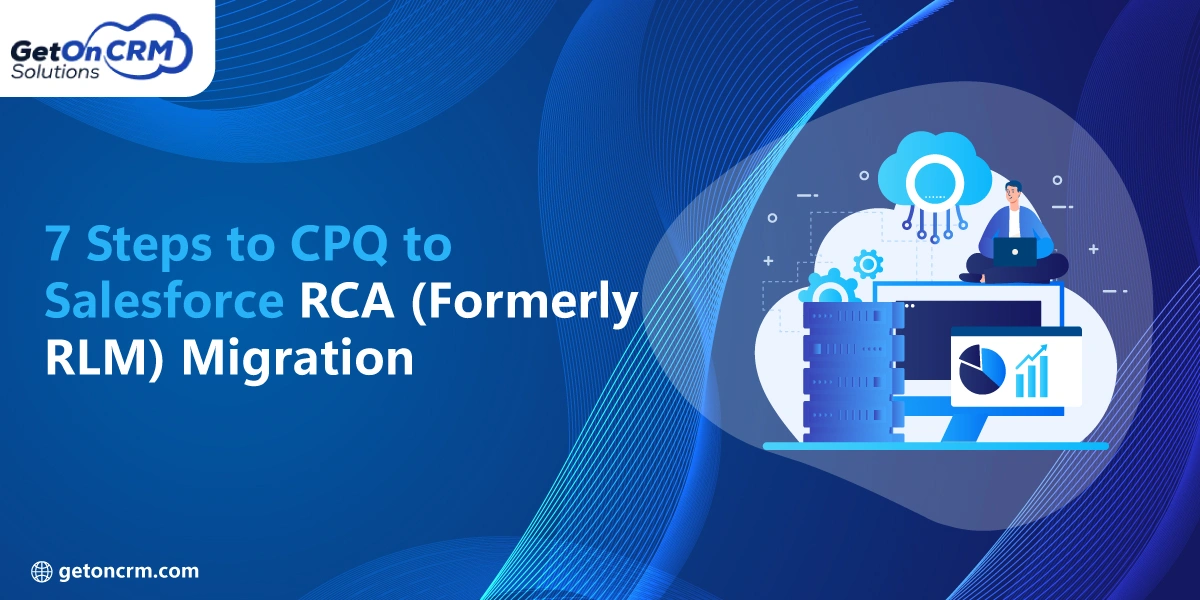
Salesforce CPQ implementation services have been helpful to businesses over the years. But the environment regarding revenue management is changing at a very fast pace. Salesforce Revenue Cloud Advanced (RCA) was previously called Revenue Lifecycle Management (RLM), and it is the next-generation technology of revenue operations.
Conventionally based CPQ systems are functional, but tend to have difficulty with complex revenue models, subscription management, and end-to-end integration through the entire quote-to-cash process.
Salesforce RCA is a platform of next-generation revenue management that was developed as an integrative part of the Einstein 1 Platform. In comparison with the managed package structure of CPQ, RCA uses Salesforce core objects and is more flexible and scalable.
Manual validation of quotes incurs up to 20% error rates and costs the company revenues and credibility. These risks are minimized by methodical migration, which enables RCA to unlock its advanced capabilities.
Step 1: Understand the Differences Between CPQ and Salesforce RCA
You should get familiar with the key difference between RCA and traditional CPQ before beginning migration.
➜ Key Areas of Difference
• Product catalog structure: RCA proposes a hierarchical and context-based catalog using sophisticated product selling models. The conventional CPQ catalog must be profoundly cleansed and redesigned to adapt to RCA’s structure.
• Pricing and discounting mechanisms: The pricing regulations and discount schedules of CPQ need to be translated by hand into the Business Rules Engine of RCA. Any custom discounts, price rules, and look-up tables must be converted into the native tools of RCA, such as the Pricing Procedures.
• Quote-to-cash workflow: Although CPQ was mainly concerned with quoting, Agentforce revenue management within RCA encompasses the full lifecycle of revenue, including the initial quote process, followed by billing, revenue recognition, and renewal.
• Revenue lifecycle capabilities: RCA is used to support recurring invoices, price-based invoices, multi-year contracts, and complicated revenue recognition cases that CPQ could not cover.
➜ Why This Step Matters
Teams that do not analyze this ahead of time usually find incompatibilities in the middle of the migration, leading to delays and budget overruns. When you know what should be rebuilt and what can be directly migrated, project schedules will be more precise.
Step 2: Assess Your Current CPQ Environment
Perform a thorough analysis of your current CPQ system before touching any migration tools. Agentforce revenue management requirements start with understanding what you already possess.
➜ Elements to Review
• Product catalogs: How many products are there? What is the structure of hierarchy? Which products are bundled? Migration effort is dependent on an understanding of catalog complexity.
• Pricing rules and discount schedules: Record all price guidelines, discount scales, and special pricing deals. These are your blueprints to the Business Rules Engine configuration of RCA.
• Quote templates should be stored, and their usage patterns should be recorded. What are the templates that are in active use? Which can be retired? Migration consolidates templates, which makes their subsequent maintenance easier.
• Approval workflows: Map every approval path, including conditional routing and escalation rules. These processes should be recreated in the native automation of RCA.
• Customizations and integrations: Any personalized Apex class, Visualforce page, and external integration has to be assessed to check if it is RCA compatible.
➜ Deliverables of This Step
The entire system inventory gives insight into the scope of the migration. This document is your one source of truth in your project.
Dependency documentation will show what components should be migrated as a block. You cannot migrate products without pricing or approvals without pricing rules.
Detection of redundant configurations offers chances of simplification. Most organizations find that they are preserving duplicate or old logic that is not worthy of migration.
Also Read : Salesforce CPQ Partners in India That Can Revolutionize Your Sales Process
Step 3: Clean and Prepare Your Data
Data quality is critical for successful migration. Salesforce CPQ solutions tend to store years of irregular data. Migration is the ideal solution to cleanup.
➜ Data Areas to Prepare
• Product data: Product names, description and properties should have consistent conventions. Replicated products should be consolidated or eliminated.
• Pricing structures: Evaluate pricing levels, discount arrangements, and special pricing arrangements. Get rid of outdated or conflicting price regulations.
• Customer and contract information: Check the customer record and contract terms and renewal date. Lack of full contract data leads to issues in RCA lifecycle management.
• Quote history: Historical quotes do not have an automated migrating tool. Determine what quotations should be migrated and archived.
➜ Best Practices
Before migration, use Salesforce Duplicate Management tools to detect and combine duplicates.
Standardized naming simplifies mapping and reduces post-migration confusion.
Document distributions, null rates, cardinality, and variance patterns. These metrics will form your benchmark of post-migration validation.
Step 4: Map CPQ Data and Processes to Salesforce RCA
Mapping will make sure your current business logic fits the framework of RCA. Salesforce CPQ consulting experts suggest developing detailed mapping matrices of all the components.
➜ What Needs Mapping
• Products and bundles: CPQ has a product structure that aligns with the hierarchical catalog model of RCA, but the logic of bundles frequently requires redesign.
• Price books: The price books of CPQ are pricing contexts, which adjust depending on customer, channel, or region.
• Salesforce CPQ solutions: Salesforce discount plans must be translated into the Business Rules Engine of RCA. All the types of discounts require specific consideration. The processes of approval should be reassembled with native automation of RCA.
• Subscription and billing rules: Map CPQ can be used with RCA to handle all the billing functions, including usage-based billing and complex invoicing cycles.
➜ Tips for Effective Mapping
Use documentation from the assessment phase as your starting point. Each of the items listed under Step 2 requires a mapping decision.
Participate in mapping sessions by engaging with business and technical teams. Technical teams are knowledgeable of feasibility, whereas business users are knowledgeable about intent.
Step 5: Rebuild Product Catalog and Pricing Models in RCA
RCA employs alternative architecture, and product structures may require thorough redesign. RCA requires appropriate catalog organization in CRM revenue management.
➜ Tasks in This Step
• Rebuild product hierarchies: Use the flexibility of RCA to build logical product groupings.
• Configure pricing rules: In RCA, each CPQ price rule evolves into a pricing process. Adequately test to verify pricing.
• Set up bundles and packages: RCA also allows more advanced bundle definitions compared to CPQ, such as dynamic bundles that can adjust to the specifics of the customer.
• Define subscription and usage pricing: RCA is ideal in intricate billing situations that CPQ has failed to address, such as tiered usage charging and hybrid subscriptions.
➜ Benefits
Better flexibility enables pricing strategies that could not have been supported by CPQ. The context-based pricing of RCA automatically adjusts to channels, geography, and time, as well as to customers.
There is increased future scalability, which implies that new products are launched in less time.
Step 6: Test the Migration Thoroughly
Testing will make sure that the new system works as intended before it goes live. CPQ implementation services professionals dedicate 35-40% of the project schedule to validation.
➜ Types of Testing
• Unit testing: Every pricing rule, product setup, and approval process must be tested separately to verify desired functionality.
• Integration testing: The products, prices, and approvals should interact properly to produce the correct quotes.
• Salesforce CPQ consulting teams focus on User Acceptance Testing (UAT) in the end as the last validation. Simulated users run real-life applications using production data.
➜ What to Validate
• Quote generation: Try different combinations, discounts, and special prices of the product.
• Pricing accuracy: Compare CPQ and RCA outputs for identical configurations to catch pricing discrepancies.
• Approval workflows: Check approvals routes correctly, escalate properly, and accomplish within the required time.
• Contract creation: Make sure that contracts reflect all quote information and are correctly integrated with downstream billing.
Finalize the first 10 percent, then 25 percent, and then 50 percent, and correct the flaws as you move on, instead of finding out that there are systemic problems once everything has migrated.
Step 7: Deploy, Train, and Optimize
Deployment can be done after the tests show that the system is ready. Salesforce CPQ integration with other systems should be properly planned to reduce disruption.
➜ Key Deployment Activities
• Final data migration: Keep doing both tasks at once, keeping CPQ operational during the initial weeks to compare results.
• Production deployment: Plan deployment when activities are low, and also, rollback plans should be in place.
• Performance monitoring: Monitor the response time of the watch systems, the error rate, and user adoption rates.
➜ Training and Adoption
• Train sales teams and administrators: The interface of RCA is very different compared to CPQ. Before users can go live alone, they require practical practice.
• Provide user documentation: Video tutorials and quick reference guides accelerate proficiency.
• Gather feedback for improvements: The reviews in the first weeks of deployment reveal ways to optimize the product.
Common Challenges in CPQ to RCA Migration
➜ Typical Challenges
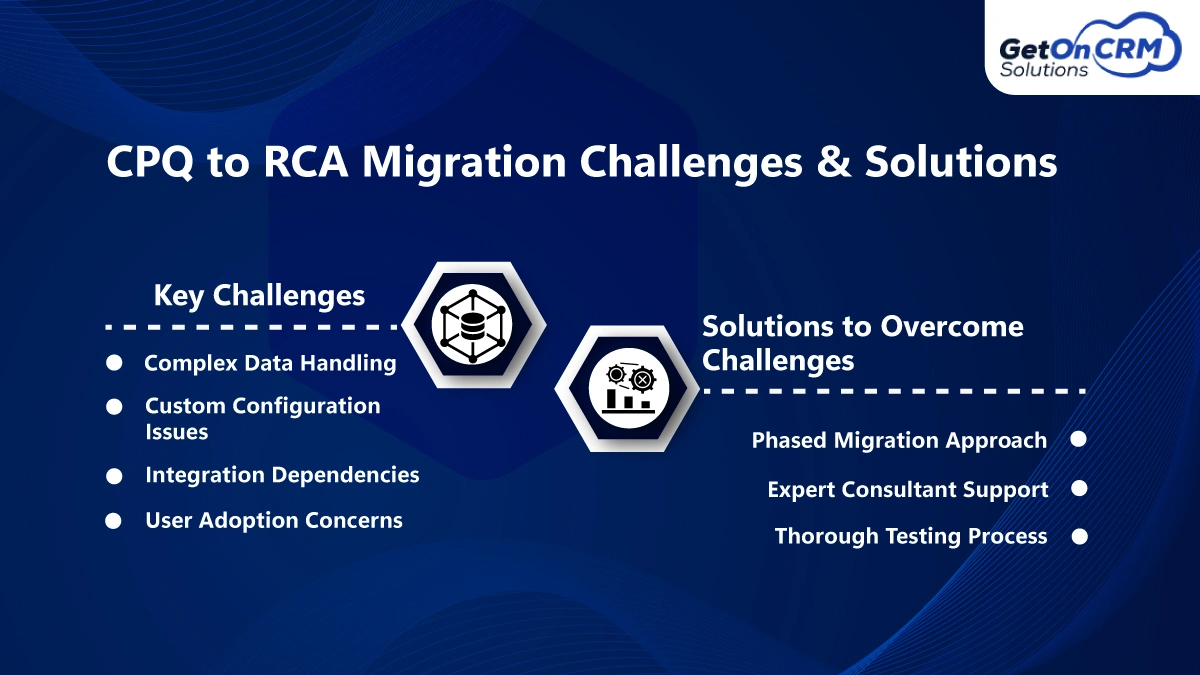
• Data complexity: The product catalogs containing thousands of items and complex price regulations require a large time frame to clean up.
• Custom CPQ configurations: Custom Apex code or workflows are found with no description of what they are used to do or how they actually work.
• Integration dependencies: External systems that receive CPQ data structures must be modified to accept RCA data.
• User adoption issues: Customers accustomed to CPQ do not appreciate new interfaces and workflows.
➜ How to Overcome Them
• Use phased migration: Migrate product families or business units incrementally rather than everything simultaneously.
• Engage experienced consultants: Pattern recognition helps them to avoid typical errors, and their troubleshooting is quicker.
• Conduct thorough testing: It is much cheaper to identify problems when they occur in the test phase as opposed to finding them when they occur in the production phase.
Also Read : Top Salesforce CPQ Consultants in India for Enterprise Revenue Automation
Benefits of Migrating to Salesforce RCA
The sophisticated revenue lifecycle management has brought together systems that were not so closely connected before. Recognize revenue, quote, contract, and bill on one platform.
Scalability and flexibility are beneficial in the growth of a business. RCA is capable of managing the growing volume of transactions and product complexity without slowdown.
The enhanced automation minimizes manual procedures during revenue operations. Agentforce revenue cloud also enables and facilitates autonomous processes that were originally developed on a custom basis by CPQ.
Improved analytics and reporting give visibility that CPQ was unable to match. Native Salesforce reporting records the revenue metrics throughout the lifecycle.
Greater integration with the Salesforce ecosystem uses Sales Cloud, Service Cloud, and Marketing Cloud information.
Ready to Migrate from CPQ to Salesforce RCA? Let’s Make It Simple
The migration of CPQ to Salesforce RCA modernizes the revenue operations of companies that are ready to scale. The platform supports complex revenue models that traditional CPQ struggled with, including subscriptions, usage-based pricing, and multi-channel selling.
CPQ implementation services providers emphasize following a structured 7-step approach to reduce risks and ensure smooth transitions. Each step builds on previous work, creating cumulative progress toward migration success.
Organizations that migrate successfully unlock greater efficiency and scalability in their quote-to-revenue processes. Salesforce CPQ integration experts are ready to guide your migration journey.