
Growing businesses are often confronted by the difficulties of complicated pricing frameworks, fragmented billing systems, and lengthy deal processes that delay revenue collection. Without a powerful agentforce revenue management, revenue processes are likely to be manual, disjointed, and hard to scale. As a result, many organizations invest in Salesforce Agentforce, Revenue Cloud, and structured Salesforce revenue-management systems in order to control such problems and create predictable expansion.
The modern revenue operations are significantly more advanced than they were some years ago. Managing subscriptions, usage-based pricing, bundled services, renewals, upsells, international taxation requirements, and tiered approvals are managed by firms. When these interdependent areas rely on spreadsheets or different systems, the rate of errors increases, the process of approval takes a long time, and revenue leakage becomes a common occurrence.
Scalable revenue operations are no longer optional for organisations targeting 2x–3x growth. Companies with automated revenue processes achieve up to 30% faster growth, while nearly 60% face billing and pricing challenges during expansion. To scale successfully, systems must handle rising transaction volumes, new products, multi-region billing, and evolving pricing models seamlessly.
In this case, Salesforce Agentforce revenue management is the solution that directly offers a practical effect, changing the lives of the sales, finance, and operations teams by placing these units on a single platform, automating repetitive processes, and providing a real-time view of performance to the leadership.
Organized Salesforce Revenue Cloud services enable businesses to change the whole quote-to-cash process. Revenue Cloud helps in an integrated and automated revenue lifecycle, including product configuration and pricing, billing, and recognition of revenue. What it yields is increased accuracy, accelerated deal cycles, greater compliance, and scalability to support long-term growth.
What Is Salesforce Revenue Cloud?
➜ Overview of Salesforce Revenue Cloud
The Salesforce Revenue Cloud solution has everything you need to handle all of your revenue needs in the Salesforce ecosystem. It unifies the pricing, quoting, contracts, billing, and revenue recognition in a single system.
Instead of using different systems to make CPQ, invoicing, and accounting decisions, organizations use a common data model. Such a strategy reduces redundancy and improves coordination between sales and finance teams.
An expert Salesforce revenue cloud organization plans and implements solutions with industry-specific demands. Being a trusted partner, experts will make sure that all workflows are helping to ensure operational efficiency and compliance.
The Salesforce Agentforce Revenue Cloud is powerful because of its ability to integrate. Sales departments produce valid quotes; operations handle update requests to the contract; the teams in finance automate billing and revenue recognition; the leaders have real-time dashboards. All people work according to one truth.
➜ Key Business Problems It Solves
1. Revenue Leakage and Manual Processes
One of the most prevalent latent problems with growing businesses is revenue leakage. Pricing updates that are done manually, irregular approvals of discounts, and tracking done by using spreadsheets are usually subject to errors. Even minor errors in quotes or invoices will decrease the profit margins in the long run.
Having a structured agentforce revenue management Salesforce strategy, automatically, pricing rules, and discount limits are automated, as well as approval workflows. This saves human error, enhances consistency in pricing, and secures revenue at all the sales cycle levels.
2. Disconnected Sales, Finance, and Operations Teams
The utilization of varied systems by teams results in augmented communication gaps. Sales might close a deal, but finance might not know everything they need to know about the contract. It results in a delay in billing, controversies, and increases in payment cycles.
One platform links sales, finance, and operations to a single Salesforce revenue cloud solution. All people operate based on the same data, which enhances the process of collaboration, accelerates invoicing, and minimizes the number of reconciliation problems.
3. Lack of Real-Time Revenue Visibility
Leaders require accurate and clear revenue information to make the right decisions. Without centralized reporting, forecasting is ineffectual, and planning is hazardous.
Enhanced Salesforce revenue management dashboards offer real-time insights into subscription, renewal, pipeline value, and recognized revenue. Such depth of understanding aids executives in making plans about their hiring, investing, and expansion with more confidence.
Core Components of Salesforce Revenue Cloud
➢ Configure, Price, Quote (CPQ)
CPQ forms the basis of a fast, smart sales process. It allows the sales teams to provide accurate quotations with the help of manual calculations and approval iterations.
• Revenue Cloud CPQ supports:
• Fully automated product configuration.
• Guided selling workflows
• Discount control and dynamic pricing.
• Approval automation
• Error-free quote generation
Under CPQ, the sales representatives are asked direct questions, and the system builds the correct product package automatically in accordance with established rules. This eliminates speculation and inaccurate pricing. Given the implementation of a Salesforce Revenue Cloud, a certified partner adjusts the pricing logic in a way that not only safeguards the margin but also provides the flexibility to make special deals.
Firms that re-engineer their CPQ activities tend to decrease the duration of quote generation by 4060, which directly enhances the productivity of sales and the time to respond to customers.
➢ Subscription & Contract Management
Subscriptions have become the norm in most industries, both software and manufacturing services. The operation of these models may soon get out of control.
Revenue Cloud supports:
• Relaxed billing cycles for subscriptions.
• Leveled and usage-based pricing.
• Automated contracting.
• Renewals, upsells, and amendments.
• Reminders and alerts of renewal.
With the help of organized agentforce revenue management, companies automate renewal processes and minimize churn. Automation of a contract life cycle can be used to make sure that all the amendments or upgrades are properly tracked and reflected in billing and revenue recognition. This brings uniformity in the departments and enhances satisfaction among customers.
➢ Billing & Invoicing
The complexity in billing is also enhanced when firms expand to other markets and are more advanced in their pricing strategy. The various currencies, taxation laws, and billing schedules should all be taken care of.
Revenue Cloud enables:
• Automated invoicing
• Billed consolidation on numerous products.
• Usage-based and milestone billing.
• Integration of tax calculation.
• Payment reconciliation
An effective Salesforce Revenue Cloud implementation links billing to ERP and finance systems. This decreases manual reconciliation work and accelerates the closing of the month-ends.
Automation and system integration tend to increase the accuracy of billing and reduce administrative expenses for organizations that collaborate with a competent Salesforce Revenue Cloud company.
➢ Revenue Recognition
The standards against which revenue recognition is required to be in line include IFRS 15 and ASC 606. Errors in this regard may provide financial and legal risks.
Companies benefit through organized Salesforce revenue-cloud services by receiving:
• Revenue schedules and automated ones.
• Deferred revenue tracking
• Fair financial reporting.
• Audit-ready documentation
• Reduced compliance risk
The progressive Salesforce revenue cloud services make revenue in the right way when it comes to subscription renewal, bundled services, and long-term contracts. This makes finance teams more open and gives clients and auditors more faith in them.
Also Read : Salesforce Agentforce Features Every Decision Maker Must Know
End-to-End Salesforce Revenue Cloud Services
➨ Revenue Cloud Consulting & Strategy
A successful change always starts with a properly thought-out plan.
The activities included in the consulting phase normally involve:
• Revenue operations maturity evaluation.
• Gap analysis
• Process mapping
• Architecture planning
• Roadmap creation
This stage involves professionals planning a complete Agentforce revenue management Salesforce to correspond to the organizational growth goals.
Consultants, being a committed salesforce revenue optimization partner, are target-oriented, i.e., to decrease the time of a quote by 50 percent or improve renewal rates by 15 percent.
The engagement will be easy because working with one of the top Salesforce revenue cloud consulting partners would guide the entire engagement based on best practices.
➨ Implementation & Customization
An organized Salesforce Revenue Cloud implementation transforms the business roadmap into a working system. This stage focuses on configuration, integration, user enablement, and process automation.
Implementation activities between core activities are:
• CPQ setup and sophisticated pricing regulation.
• Subscription and contract setup.
• Workflow design and automation, Billing.
• Individual approval and notification procedures.
• API connections to ERP, payment, and tax systems.
• Security settings and role-based access controls.
A knowledgeable Salesforce Revenue Cloud implementation partner will use established models to reduce the risk of the project and shorten deployment schedules. Accurate setups ensure that the pricing is accurate, the billing processes are smooth, and the internal policies are adhered to.
The following are often demanded to be customized:
• Pricing arrangements that are industry-specific.
• International tax and regulatory regulations.
• Complicated approval lines.
• Partner sales or channel sales processes.
The Salesforce revenue cloud partner that is trusted will provide the scalability of these customizations, their compatibility with upgrades, and their suitability for future business growth.
➨ Migration & Data Management
One of the most important stages of a revenue cloud transformation is data migration. The poor quality of data compromises the accuracy of billing, tracking of contracts, and reporting of revenues.
Migration services normally consist of:
• Importation of legacy contracts and subscriptions.
• Pricing validation and product data validation.
• Migration of historical billing and invoices.
• Data cleansing and standardization.
• Compliance checks and audits of security.
A credible Salesforce revenue management checks all the data that has been migrated before going live. Such a practice eliminates billing differences and reporting problems subsequently. Properly organized data keeps the total revenue management on the right track, increases the accuracy of data displayed in the dashboard, and instills trust in the stakeholders.
➨ Testing, Deployment & Optimization
During comprehensive tests, it ensures that the system can do what it is constructed to do in a real-world environment. Not following this step might result in pricing problems or the disruption of the billing after the launch.
Key testing steps include:
• Individual configuration testing.
• Systems testing: Practice of system integration.
• UAT with business teams.
• High-volume transaction performance testing.
• Checks on security verifications and access control.
Continuous improvement is still needed after deployment. The system has to change with products, pricing models, or regions. The Salesforce Agentforce revenue cloud platform allows constant improvements without significant interference.
Benefits of End-to-End Salesforce Revenue Cloud Services
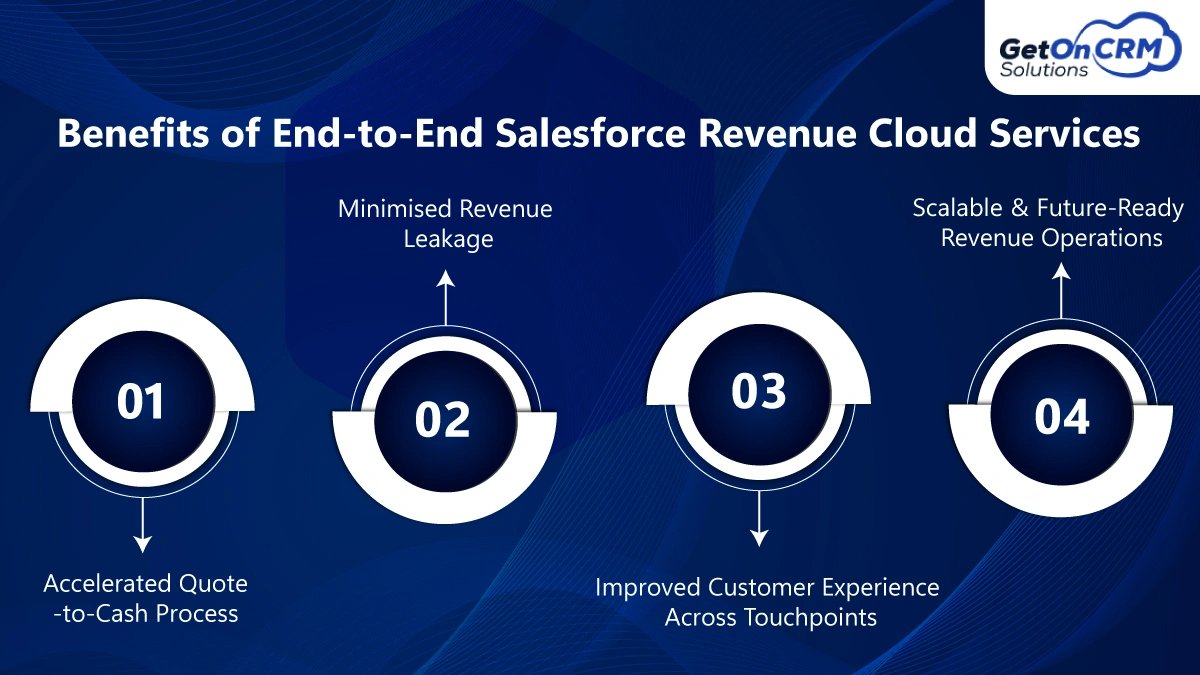
1. Faster Quote-to-Cash Cycles
Automation speeds up all processes of creating quotes to receiving payments. Sales teams finalize deals faster with set pricing policies and processes, and reduce back-and-forth delays. A significant number of organizations reduced deal approval time by 30% and hence improved cash flow and efficiency generally.
2. Reduced Revenue Leakage
Strengthy Salesforce agentforce revenue management controls exclude pricing inaccuracies, unauthorized discounts, and lost renewals. Revenue is accurately captured through automated billing and tracking of contracts, which safeguards margins and minimizes financial risk.
3. Improved Forecast Accuracy
Live dashboards provide a good representation of pipeline, billing, and revenue recognition data. The common viewpoint increases accuracy in planning by 2025 percent and helps in making better business decisions.
4. Enhanced Customer Experience
The customers enjoy accurate quotes, invoices, and renewals. An efficient and continuous process generates confidence and enhances long-term relationships.
5. Scalable and Future-Ready Operations
The properly developed Salesforce revenue cloud solution facilitates the process of entering new markets, subscriptions, and pricing. Firms with a strategic salesforce revenue optimization partner are able to predict better and enjoy stable growth in the long term.
Those companies that work with a strategic salesforce revenue optimization partner have the ability to improve the predictability of revenue.
Key Success Factors for Implementing Salesforce Revenue Cloud
➾ Align Stakeholders Early
At the initial stages, sales, finance, and IT teams are to work together. Well-defined roles, common objectives, and frequent communication remove confusion at a later stage. Timely alignment saves on rework, maintains a shorter schedule, and makes the system address the requirements of each department.
➾ Standardize Pricing Structures
Categorization of products and pricing policies simplifies them. Any Salesforce revenue cloud partner can set up CPQ and billing with clean and structured data. Standardization also cuts down on mistakes and makes it easier to make changes in the future.
➾ Prioritize Automation
Work on approvals, renewal, billing process, and reporting automation. Automation does away with manual labor, minimizes delays, and improves uniformity. The better the processes are streamlined, the better the payback.
➾ Use Analytics for Continuous Improvement
Insights into Salesforce revenue management are intensified with built-in reporting and dashboards. The KPIs allow leaders to monitor the performance, bottlenecks, and achieve performance improvements over time. When organizations engage with the top Salesforce revenue cloud consulting partners, they tend to achieve faster user adoption rates, reduced disruptions, and no hassles during long-term transition.
Why Choose a Salesforce Revenue Cloud Partner
Revenue Cloud implementation without professional assistance may delay the ROI, increase costs, and lead to needless complexity. The processes of revenue include sales, finance, operations, and IT. Even a small configuration error can have an impact on pricing, billing, or revenue recognition. Thus, it is important to hire the appropriate experts.
A reliable Salesforce revenue cloud company has:
• Rated Salesforce consultants.
• Industry-related knowledge.
• Established implementation strategies.
• Reduced project risk
• Organized after-implementation services.
A seasoned Salesforce revenue cloud partner will also make sure that the solution is not only technical but also business-oriented. They know the impact of pricing models, contract structures, and billing processes on revenue performance.
A competent Salesforce revenue cloud implementation partner can deliver a faster deployment, reduce the number of customization errors, and utilize previous project best practices. This results in an easier adoption and a faster time to value.
Collaborating with a specialized Salesforce revenue-optimization partner also ensures that the revenue procedures contribute to the long-term development. Whether it comes to improving margins or improving renewal rates, it is all about deliverables as opposed to system installation.
Real-World Impact of Agentforce Revenue Management
Companies that utilize a systematic agentforce revenue management system have a tendency to experience observable and measurable results. Instead of using manual methods and disintegrated systems, they develop automated and data-driven revenue operations, which support growth.
Some of the most popular features are:
➥ 40% quicker quote creation, through automated item configuration and pricing guidelines.
➥ 25% decrease in billing errors by integrating billing and validation processes.
➥ 15% growth in renewal rates using automated reminders and tracking of contracts.
➥ 20% enhancement in prediction efficiency with the use of a real-time dashboard and revenue insights.
These advantages are interregional, business-unit, and product-line in nature when operated by Salesforce Agentforce Revenue Cloud. Working teams are based on a single source of truth, and this reduces confusion and improves collaboration.
Organizations, using a tactical agentforce revenue management salesforce strategy, leave the reactive revenue monitoring practice and embark on proactive revenue management. Automation, visibility, and formal governance ensure that problems are preempted, and not fixed.
Also Read : Top Salesforce Agentforce Partners in India for 2026
The Role of a Trusted Salesforce Revenue Cloud Company
The choice of the implementation partner is one of the critical elements in project success. Revenue Cloud deals with pricing, contracts, billing, and compliance, and in the absence of the necessary skill sets, delays and expensive mistakes can follow.
An established Salesforce revenue cloud company:
• Has a thorough knowledge of subscription, hybrid pricing, and usage-based pricing.
• Tests applied compliance and accounting standards.
• Templates testing and validation.
• Make sure that there are smooth system integrations.
• Provides continuous performance management and optimization.
A knowledgeable team has gone ahead to visualize obstacles before they arise and come up with solutions that are scalable, secure, and in line with long-term growth plans. The top Salesforce revenue cloud consultation partners and specialists are interested not only in deployment but also in a tangible business effect.
They are aimed at helping organizations get maximum adoption, improve the predictability of revenues, and realize the ongoing value of their revenue cloud investment.
Ready to Scale Your Revenue? Let’s Build a Smarter Revenue Engine
Growth of revenues is a matter of integration, automation, and acumen nowadays. Isolated systems hinder transactions, augment mistakes, and reduce transparency. The challenges are turned into opportunities through integrated lifecycle management, which runs on Agentforce revenue management.
CPQ, subscription management, billing, and revenue recognition are all unified in Salesforce Revenue Cloud implementation through the use of end-to-end Salesforce Revenue Cloud services. Having an organized deployment, companies make their processes simpler and enhance their forecasting.
With the abilities of Salesforce Agentforce Revenue Cloud and in partnership with a skilled top Salesforce Revenue Cloud implementation partner, organizations develop scalable revenue engines that contribute to growth, novelty, and sustainability. Contemporary revenue management has ceased to be a choice of an expanding business, but a strategic necessity.
Those companies investing in an all-inclusive Salesforce revenue cloud solution and partnering with the top Salesforce revenue cloud consulting partners have steady and foreseeable growth. The future revenue operations lie in the organizations that integrate their systems, automate their operations, and establish effective relationships. It is time to change your revenue lifecycle and scale to success.