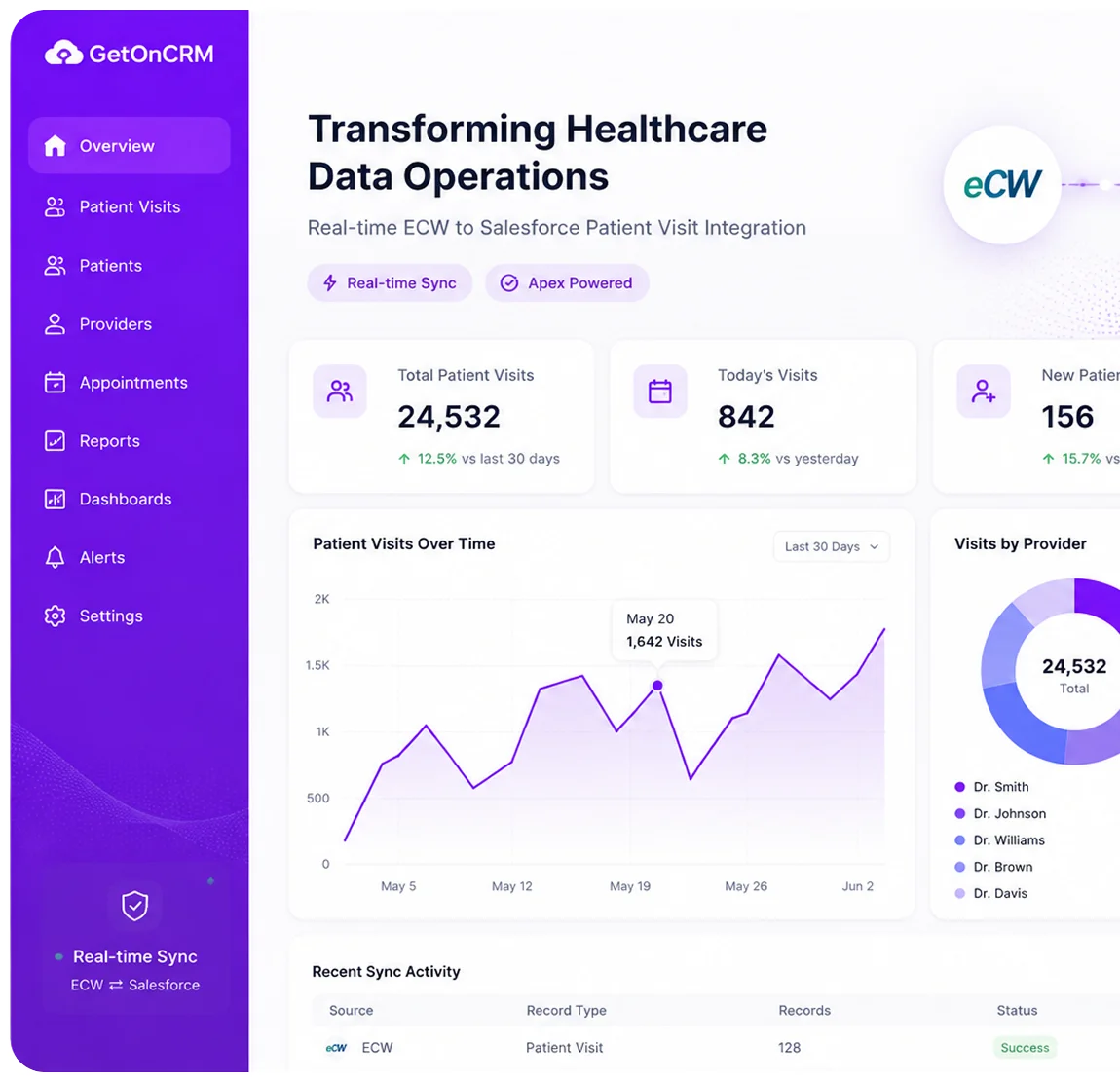
How GetOnCRM built an Apex-driven, metadata-powered integration pipeline that eliminated manual data entry and created a real-time Salesforce patient visit ecosystem for a healthcare organization.
A forward-thinking healthcare organization partnered with GetOnCRM — a Salesforce Ridge Consulting Partner — to eliminate the operational drag of manual patient data management and build a scalable, automated integration between their eClinicalWorks (ECW) electronic health record system and Salesforce. Prior to the engagement, administrative teams were spending significant time on manual data entry, patient records were riddled with duplicates, and the absence of automated error handling meant that data pipeline failures went undetected for extended periods.
GetOnCRM designed and implemented a fully automated, Apex-driven ECW-to-Salesforce patient visit integration pipeline using Box as a secure middleware layer. The solution featured a metadata-driven field mapping framework, a four-path contact resolution engine, and a comprehensive Task-based audit trail — all operating on a daily automated schedule without staff intervention.
The result: complete elimination of manual patient data entry, near real-time demographic accuracy, 100% audit Task completion across all processed visits, and a scalable foundation that positions the organization for future EHR-to-CRM data workflow expansion. This case study demonstrates GetOnCRM’s expertise in delivering constraint-aware, production-grade Salesforce healthcare integration solutions that create lasting operational value.
The integration transformed our patient data operations from a manual, error-prone process into a fully automated daily pipeline — delivering the data trust and operational efficiency we needed to scale.
Healthcare Organization Leadership
Administrative staff spent significant time each day manually transcribing patient visit data from ECW into Salesforce, creating a high-error, high-effort workflow that diverted capacity away from patient-facing activities.
Repeat patient visits were not reliably linked to existing Salesforce Contact records, resulting in duplicate entries and incomplete patient histories that undermined the integrity of clinical and operational reporting.
Managers lacked timely access to patient visit data within Salesforce, making it difficult to monitor care activities, track provider performance, or generate accurate operational reports.
Without automated synchronization, Salesforce Contact records frequently contained outdated demographic information, degrading the accuracy of care coordination and outreach efforts.
The absence of automated error alerting meant that data processing failures went undetected — creating invisible data gaps that could only be identified through time-intensive manual audits.
A manual, human-dependent data workflow had no capacity to grow with patient volumes, making the existing approach fundamentally unsustainable as the organization expanded.
GetOnCRM architected and delivered a fully automated, three-phase Apex pipeline that ingests ECW patient visit CSV exports via Box and upserts them into Salesforce on a daily schedule. The solution was designed from the ground up to be idempotent, resilient to failures, and extensible — enabling the organization to grow its integration footprint without rearchitecting the core pipeline.
Rather than building a brittle point-to-point integration, GetOnCRM took a metadata-driven approach that separates configuration from code — meaning field mappings, matching rules, and processing parameters can be updated by administrators without developer involvement. This architectural decision dramatically reduces the long-term cost of maintaining and evolving the integration.
Box was implemented as the secure intermediary between ECW’s SFTP export process and Salesforce’s API-driven ingestion layer. Each morning at 6:00 AM, an Apex-based scheduler (ECWBoxSyncScheduler) authenticates with Box via OAuth, applies an incremental timestamp filter to identify only new ECW files, and creates ECW_Upload__c staging records in Salesforce to track each file through the pipeline. This incremental approach ensures efficient processing — only new data is ever touched, regardless of how many historical files reside in the Box environment.
The pipeline operates across three clearly defined phases. In Phase 1, the scheduler polls Box and stages new file metadata in Salesforce. In Phase 2, ECWFileAttachQueueable downloads each file and stores it as a Salesforce ContentVersion record, self-chaining to process multiple files sequentially without exceeding platform limits. In Phase 3, ECWPatientVisitService parses the CSV data, executes contact resolution logic, and upserts patient visit records — including demographic updates and address management — into the appropriate Salesforce objects.
The most technically sophisticated component of the solution is its four-path contact resolution engine, which handles every possible patient matching scenario. Incoming visits are matched to existing Salesforce Contacts via Medical Record Number (MRN) as the primary identifier, or by name combined with date of birth as a secondary fallback. Where a match is found, the existing Contact is linked; where no match exists, a new Contact is created. This deterministic, rules-based approach eliminated duplicate contact creation and ensured that every patient visit is associated with the correct longitudinal record — regardless of data completeness.
All 30 ECW-to-Salesforce field mappings are managed through custom metadata records — not hardcoded in Apex. This architectural pattern means that adding new fields, renaming mappings, or adjusting data transformation rules requires only a configuration change, with no code deployment needed. For a healthcare organization operating in a rapidly evolving data environment, this flexibility represents a significant reduction in the cost and risk of ongoing integration maintenance.
The solution includes intelligent demographic update logic that compares incoming ECW visit data against existing Salesforce Contact fields and overwrites values only when the incoming data differs — preserving intentional manual updates while keeping records current. A dedicated ECWAddressService handles address management: comparing incoming visit addresses against existing residential records, inserting new Address records when needed, and syncing mailing fields via trigger automation to ensure Salesforce Contact records reflect the most current patient address information.
For every patient visit processed, the pipeline generates a corresponding Salesforce Task record capturing the specific outcome of contact resolution and address management. This creates a fully queryable audit trail that supports compliance reviews, data quality investigations, and operational reporting without requiring access to raw pipeline logs. Automated error notification via ECWErrorNotifier ensures that any pipeline failure is immediately surfaced to the appropriate stakeholders — eliminating the silent data gaps that had previously gone undetected.
The ECW to Salesforce integration delivered measurable, organization-wide impact across operational efficiency, data quality, compliance readiness, and administrative capacity. The outcomes align directly with the challenges the organization faced before the engagement — and in several areas, the solution exceeded initial expectations.
Automated Patient Visit Sync
Operational Efficiency
The complete elimination of manual patient data entry was the most immediate and visible outcome of the engagement. Daily synchronization now runs fully automatically — triggered at 6:00 AM, processing all new ECW files, and completing without any staff involvement. Administrative teams that previously spent significant portions of their day on data entry have had that capacity returned for higher-value patient engagement activities.
Data Quality & Contact Deduplication
Contact deduplication accuracy improved substantially, with repeat patient visits reliably linked to existing Salesforce records through MRN and name-plus-DOB matching. Duplicate contact creation — a persistent problem under the manual workflow — was effectively eliminated. Demographic data currency improved to near real-time accuracy, with Salesforce Contact records updated each morning to reflect the latest ECW values, ensuring that care coordination and outreach activities are based on current information.
Compliance Readiness & Auditability
Audit Task completion rates reached 100% for all processed visits, providing a complete and queryable record of every contact resolution and address management action taken by the pipeline. This audit trail dramatically simplifies compliance reviews and data quality investigations, and provides the organization with evidence of data governance practices that meet healthcare regulatory standards. The automated error notification system ensures that pipeline health is continuously monitored — eliminating the risk of silent data failures.
Scalability & Future Readiness
The metadata-driven architecture ensures that future field-level changes require only configuration updates — no code deployments, no developer hours, no regression risk. The pipeline's idempotent design means it can be safely re-run if needed, and its self-chaining file processing architecture scales naturally with increasing daily file volumes. The organization now has a Salesforce healthcare data foundation that grows with them, rather than constraining them.

For healthcare organizations managing complex, multi-system data environments, Salesforce offers a uniquely powerful foundation — combining the flexibility of a world-class CRM platform with the extensibility needed to serve as a true operational data hub. The success of this ECW-to-Salesforce integration reflects four strategic realities that make Salesforce the right choice for healthcare data operations:
Salesforce's Apex programming environment provides the computational power and platform-native capabilities needed to build production-grade data pipelines — including batch processing, asynchronous queueables, and scheduled jobs — without the overhead of external ETL tools or middleware platforms. For healthcare organizations, this means integration logic lives inside the same secure, governed environment as their operational data.
Salesforce's custom metadata architecture enables a configuration-first approach to data integration — where business rules, field mappings, and processing parameters are managed as data, not code. This dramatically reduces the cost and complexity of evolving integrations over time, giving healthcare organizations the agility to respond to changing data requirements without expensive development cycles.
Salesforce's platform-native security model — including OAuth-based API authentication, field-level security, and object-level permissions — provides the compliance-grade data governance that healthcare organizations require. The ability to generate structured audit trails as native Salesforce objects (Tasks, in this case) means compliance evidence is queryable, reportable, and accessible without specialized tooling.
By establishing clean, deduplicated, and continuously synchronized patient records in Salesforce, healthcare organizations create the data foundation necessary for sophisticated care coordination, outreach automation, and population health management. The ECW-to-Salesforce integration GetOnCRM delivered is not just an efficiency play — it is the first step toward a fully connected patient engagement ecosystem that can scale from data ingestion through to proactive, personalized care delivery.


We are Salesforce Select Partner having 100% salesforce certified team.
Copyright © 2026 GetOnCRM Solutions PVT. LTD. All Rights Reserved.