
CPQ implementation helps businesses automate product configuration, pricing, discounts, and quotes while reducing errors and delays. The cost varies based on product complexity, integrations, workflows, and data quality. This guide includes information on salesforce CPQ implementation services, CPQ implementation cost manufacturing industry, CPQ implementation cost for SAAS companies and budget planning for 2026–27.
Businesses are increasingly investing in CPQ solutions to streamline sales operations and improve pricing accuracy. Salesforce reports that CPQ can reduce quote turnaround time by 34% and pricing errors by 38%, highlighting its potential business impact.
What Is Salesforce CPQ Implementation?
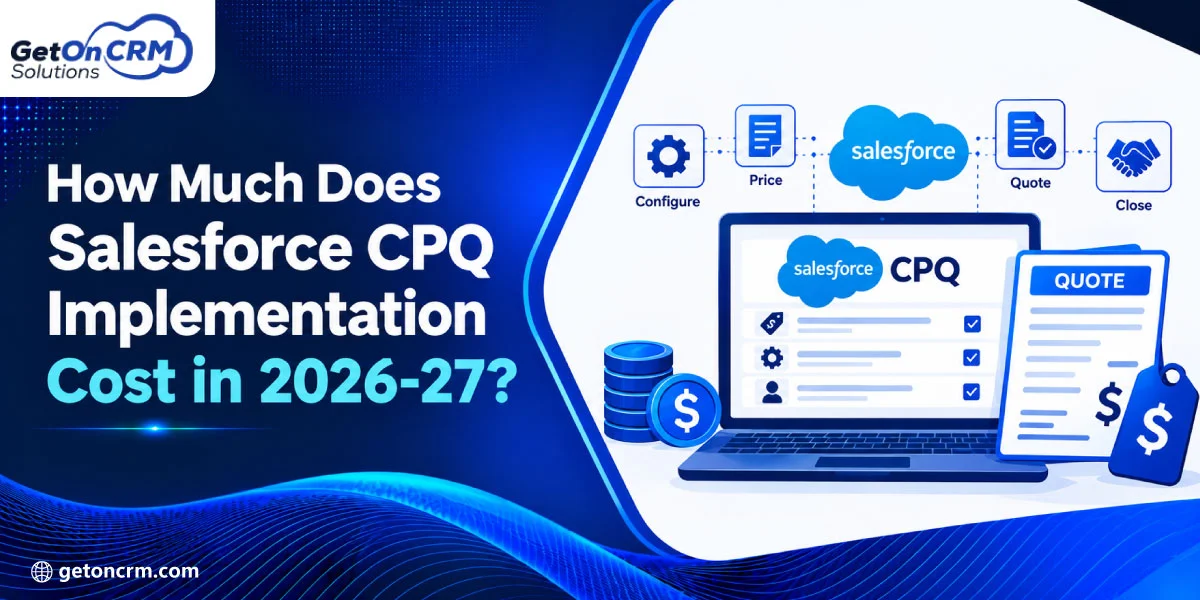
Salesforce CPQ (Configure, Price, Quote) is a native Salesforce solution that streamlines product configuration, pricing, approvals and quote creation. It can assist the sales team in generating accurate quotes more quickly, minimising pricing mistakes and managing discounting.
Salesforce CPQ solutions are adopted by B2B manufacturers with customizable products, SaaS companies with subscription products, distributors with vast SKU numbers, and professional service organizations with complicated packages.
How Much Does Salesforce CPQ Implementation Cost ?
❒ Estimated Salesforce CPQ Implementation Cost by Project Size
Salesforce CPQ implementation cost is influenced by business size, product complexity, pricing rules, integrations, customisation and user volume. Simple implementation with simple products and workflows can cost around 25,000-50,000. The range for mid-sized projects with guided selling, advanced pricing and integrations is 50,000–150,000. For enterprise implementations, global operations, complex integrations and advanced customisations, the price of these can range from 150,000+ to 400,000+.
❒ Why There Is No Fixed Salesforce CPQ Implementation Price
No fixed price for implementing CPQ as each organisation has varying sales processes and technical requirements. Complex product configurations, dynamic pricing, large user deployments, multiple ERP/billing integration, custom Apex automation, and special Lightning Web Components can drive up costs for businesses. Additional costs may be associated with data migration, testing, training, and support as well.
Also Read: Top Salesforce CPQ Consultants in India for Enterprise Revenue Automation
Salesforce CPQ Cost Breakdown: Licensing, Implementation, Customisation & Integration
The overall cost of Salesforce CPQ implementation involves software licensing, implementation, customisation, integrations, data migration, training, and support. The costs will vary depending on the size of the organisation, its business processes, technical needs and level of customisation.
➤ Salesforce CPQ Licensing Costs
Salesforce CPQ follows a subscription licensing model that costs are dependent on the edition, users, and Salesforce platform licenses. Businesses may also need additional sandbox environments, API access, or middleware to support testing and cpq salesforce integration with external systems.
➤ Implementation and Consulting Costs
Professional salesforce CPQ implementation services include requirement analysis, solution design, product, pricing configuration, testing, deployment, and project management. Skilled salesforce CPQ consulting firms can also assist companies in creating scalable workflows and steering clear of implementation mistakes.
➤ Customisation and Development Costs
For businesses that have more complicated requirements, they might require further development over and above the key capabilities of CPQ. Custom Apex automation, Lightning Web Components (LWC), approval workflows, branded quote templates, custom objects, and advanced Salesforce Flows can add to the hours and costs of implementation.
➤ Integration Costs
The number and complexity of systems to be integrated influence the integration costs. CPQ can be integrated with ERP systems like SAP, Oracle, NetSuite, billing and accounting software, CRM and eCommerce platforms. These links facilitate the continuity of product, customer, pricing, inventory and order data.
➤ Data Migration Costs
Data migration includes cleaning legacy product catalogues, reformatting pricing data, matching customer contracts and auditing data before it is imported into Salesforce. The amount and quality of data available can have a significant impact on migration time and cost.
➤ Training and User Adoption Costs
Training is provided for sales and administration teams to help them fully utilize the new CPQ system. Funds should be allocated for administrator training, role specific sales training, user documentation, and post-launch support to cater to adoption challenges and ensure the system runs smoothly.
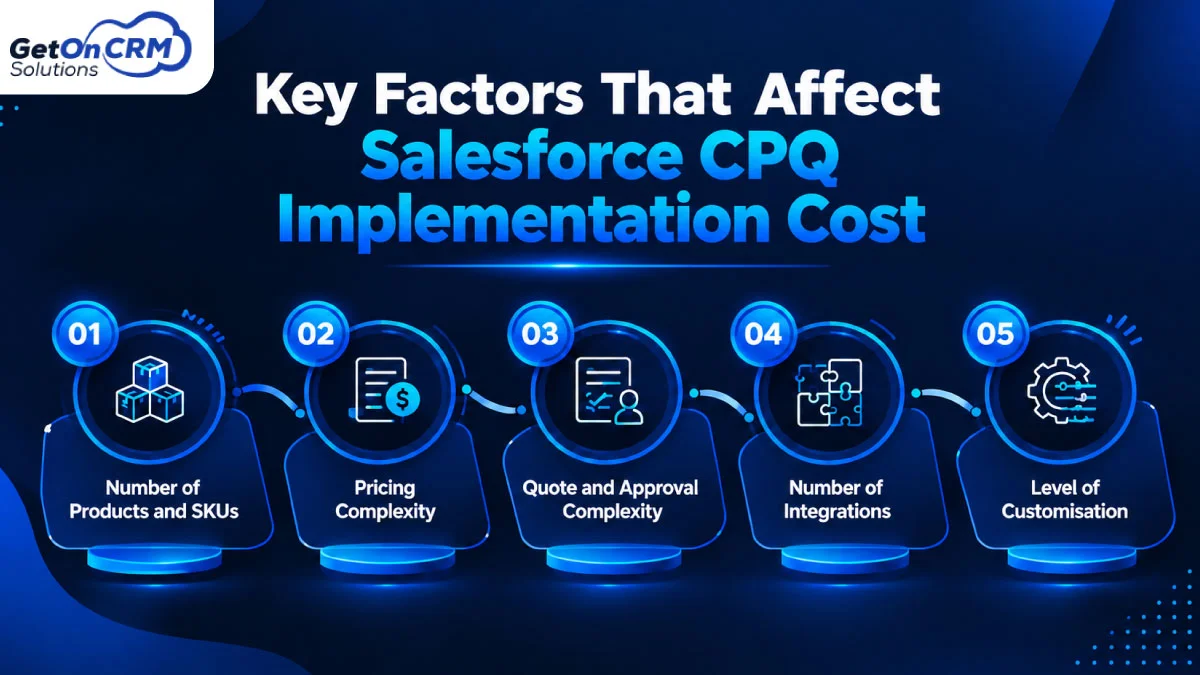
Key Factors That Affect Salesforce CPQ Implementation Cost
❒ Number of Products and SKUs
It’s easy to set up a catalog with 50 standard products. On the other hand, managing thousands of SKUs and having complex product options, hard dependencies and cross-sell rules exponentially expands the CPQ implementation services scope.
❒ Pricing Complexity
Simple flat-rate pricing is a minimum build-time option. Dynamic tier discounting, volume breaks, contract-specific pricing and usage-based consumption models, however, are complex to configure and require extensive testing to be performed, especially with advanced architecture.
❒ Quote and Approval Complexity
Single-step discount approvals are easy to establish. When margin requirements, regional regulations, or the legal conditions are not standard, multi-level executive approval hierarchies require complex workflow builds.
❒ Number of Integrations
Having all the information in a single CRM system means costs remain low. The data flow between ERP, financial ledger, and subscription platforms adds to the overall technical complexity and testing cycles when bidirectional, real-time data syncs.
❒ Level of Customisation
Use of native functions provides best-in-class functionality without custom code in keeping project costs predictable. These are higher salesforce CPQ implementation cost figures as the result of heavy custom code, non-standard objects, and custom web component development.
Salesforce CPQ Implementation Cost by Business Size
➤ Small Businesses
Small businesses may have as many as 20 users, minimal products, simple discount rules, standard PDF templates and limited integrations. The estimated project cost is in the range of 25,000-50,000 and the emphasis is on speed to market by salesforce CPQ implementation using an approach that is quick and simple.
➤ Mid-Market Businesses
Typical mid-market deployments handle 20-100 users, several product families, complex pricing rules, ERP integrations and automated approval processes. The pricing is generally between 50,000–150,000, which is a fairly flat range with a few variations based on the ability to customize it for specific clients.
➤ Enterprise Businesses
Enterprise projects can have hundreds or thousands of users, business units, international currencies, intricate ERP/billing integrations, and large-scale custom development. The investment may be as high as 150,000-400,000+ depending on the complexity of the project and the scale.
➤ Industry-Specific Cost Considerations
The manufacturing industry typically expects the CPQ implementation cost between 75,000 – 250,000+ as it involves complex BOMs, engineering dependencies, distributor channels and ERP integrations. The CPQ implementation cost for SAAS companies typically falls in the range of 50,000–180,000+, depending on such factors as subscription pricing, co-terming, usage-based billing, add-on products and automated renewals.
Also Read: Salesforce CPQ Partners in India That Can Revolutionize Your Sales Process
How to Reduce Salesforce CPQ Implementation Costs
CPQ implementation cost can be minimised by clearly defining the requirements, standardising the pricing rules, and taking advantage of native features in Salesforce as much as possible. Before migrating, cleaning product and customer data can also minimize the need for corrections and speed up data implementation.
In a phased rollout, it’s possible to introduce key CPQ features first and gradually roll out advanced functionality. Collaborating with seasoned partners who provide Salesforce CPQ implementation services can help minimize mistakes, rework, and unforeseen costs.
Salesforce CPQ vs Revenue Cloud: What Should You Budget for in 2026-27?
Salesforce CPQ is primarily used for product configuration, pricing, quoting, and approvals, whereas Revenue Cloud handles a wider range of revenue processes, including billing, subscriptions, invoicing, and revenue management.
CPQ projects may cost 25,000–250,000+, while Revenue Cloud implementations can range from 150,000–500,000+. Another factor to consider is migration, integration and customisation costs when transitioning from CPQ to Revenue Cloud.
Ready to Estimate Your Salesforce CPQ Implementation Cost?
The first step in estimating the total cost of CPQ is to gain insight into your product catalogue, pricing rules, approval workflows, and integration requirements. Be careful of these requirements and make a realistic project budget.
By consulting with certified salesforce CPQ consulting professionals, you can identify the best approach to implementation, and assessing cpq salesforce integration requirements can help you avoid hidden costs. The initial investment can also be compared to the long-term efficiency gains to determine the expected return on the investment.