
How GetOnCRM eliminated manual invoice communication for a B2B enterprise using an AI-powered Agentforce Employee Agent
A mid-size B2B enterprise running Salesforce Sales Cloud and CPQ faced a daily drag on sales productivity — invoice emails were composed entirely by hand, with reps manually locating PDFs, typing recipient addresses, and drafting email bodies from scratch. The result was inconsistent communications, frequent attachment errors, and an average of 5–10 minutes lost per email. GetOnCRM designed and deployed a purpose-built Agentforce Employee Agent that transformed this process entirely: sales reps now simply type a natural language request in the Agentforce panel, and the agent instantly retrieves the invoice, pre-populates a rich email composer — complete with recipients, subject line, body, and PDF attachment — via a Custom Lightning Type rendered directly in the conversation interface.
The solution, delivered in just two months, reduced invoice email composition time to under 60 seconds, eliminated attachment errors, and standardised communications across the entire sales team. Critically, it did so without removing human judgment from the equation — every email requires explicit rep review and confirmation before dispatch. This Agentforce implementation showcases what intelligent Salesforce automation looks like in a real enterprise sales workflow: accurate, governed, and built for scale.
The client is a mid-size B2B sales and product distribution organisation operating across multiple regions, with dedicated sales teams and account managers managing high volumes of customer transactions. Their Salesforce environment was built on Sales Cloud, extended with the CPQ Managed Package to handle complex quoting, pricing, and invoicing workflows.
As the business scaled, the gap between their Salesforce investment and day-to-day operational efficiency became increasingly visible. The invoice communication process — a routine but high-stakes activity — remained entirely manual despite Salesforce being the organisation’s system of record. Leadership recognised that the fragmented workflow was creating compliance exposure and slowing their sales teams down at exactly the wrong moment: at the point of closing and collecting revenue.
The project was initiated with a clear mandate: leverage the Agentforce platform to bring intelligence and consistency to invoice communications — without introducing external middleware, compromising data security, or removing human control over outbound customer messaging. GetOnCRM was engaged as the Salesforce implementation partner to design and deliver the solution natively within their existing Sales Cloud and CPQ environment.
Before engaging GetOnCRM, every invoice email sent by the sales team was the product of a fragmented, entirely manual workflow. The issues ran deep — from the absence of any intelligent automation to fundamental limitations in the standard Salesforce email action itself.
No automatic attachment retrieval: The standard Salesforce email agent action could not fetch invoice PDF attachments from the related CPQ Invoice record. Sales reps had to locate and attach the file manually on every single send.
No automatic attachment retrieval: The standard Salesforce email agent action could not fetch invoice PDF attachments from the related CPQ Invoice record. Sales reps had to locate and attach the file manually on every single send.
No intelligent recipient handling: From, CC, and BCC fields required manual entry. Without a reference to account contacts or billing addresses from the Invoice record, errors in recipient configuration were common.
Zero contextual awareness: The standard email action had no understanding of which invoice the rep was working on — all data had to be re-entered regardless of context, defeating the purpose of a connected CRM.

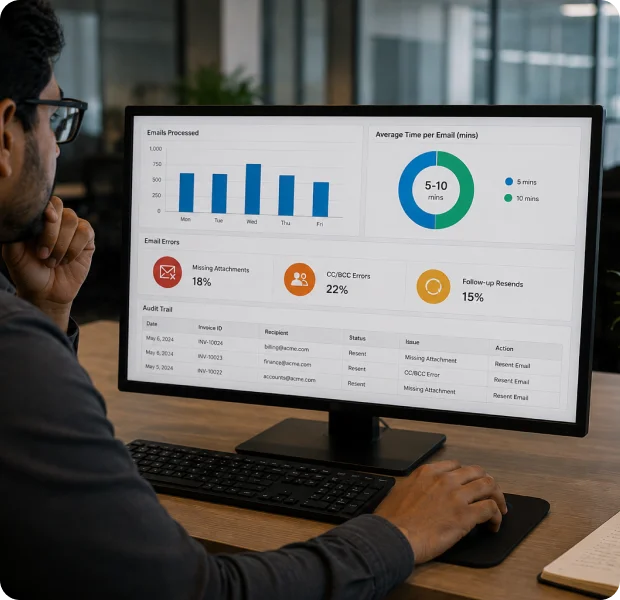
Multiple invoice emails were processed daily across the sales team, making the cumulative time cost significant.
Each email required 5–10 minutes of manual composition, attachment hunting, and recipient entry — time that compounded across teams and regions.
Errors in CC/BCC fields or missing attachments regularly triggered follow-up resends, creating audit trails that raised compliance and governance concerns.
CPQ data resides within a managed package, requiring careful use of approved Apex APIs to access invoice records and attachments securely.
Security policy strictly prohibited any automated email dispatch — every outgoing communication required explicit human confirmation before send.
The solution had to be delivered entirely within the Agentforce framework — no external middleware, no third-party tooling, no integration complexity.
A custom Apex class, annotated with @InvocableMethod, serves as the intelligence layer behind the agent action. When invoked, it performs a series of precise data operations that the standard Salesforce email action cannot: it queries the CPQ Invoice and associated Account records to derive the correct recipient (To), internal escalation contacts (CC), and compliance mailboxes (BCC); it fetches the applicable Salesforce Email Template and dynamically merges invoice-specific fields — invoice number, amount due, due date — into both the subject line and body; and it retrieves the invoice PDF via the ContentDocumentLink relationship on the Invoice record, something the native email action is fundamentally incapable of doing. The result is a structured, fully assembled email payload delivered programmatically to the Custom Lightning Type.
A dedicated Agentforce Employee Agent was configured within Sales Cloud with a specific Topic and Action for invoice email drafting. When a sales rep types a natural language request — such as ‘I need to draft an invoice email for this invoice’ — the agent identifies the intent, resolves the relevant Invoice record from context, and triggers the email drafting workflow automatically within the conversation panel. No form filling, no navigation, no manual lookup required.
The pipeline operates across three clearly defined phases. In Phase 1, the scheduler polls Box and stages new file metadata in Salesforce. In Phase 2, eClinicalWorksFileAttachQueueable downloads each file and stores it as a Salesforce ContentVersion record, self-chaining to process multiple files sequentially without exceeding platform limits. In Phase 3, eClinicalWorks PatientVisitService parses the CSV data, executes contact resolution logic, and upserts patient visit records — including demographic updates and address management — into the appropriate Salesforce objects.
The visual centrepiece of the solution is a Custom Lightning Type (CLT) built using Lightning Web Components and registered natively within the Agentforce framework. The CLT renders a fully interactive email composer directly inside the Agentforce conversation panel — not as a plain text response, but as a rich, structured visual card that mirrors the experience of a dedicated email client. Every field is pre-populated on arrival: From (org-verified sender), To (billing contact from the Invoice), CC and BCC (account team or configured defaults), Subject (merged from Email Template), Body (rich text with invoice data merged in), and an Attachments section displaying the invoice PDF ready to send. The sales rep reviews the full email in context, with the ability to edit any field before committing.
Perhaps the most strategically important design decision in this implementation is what the agent cannot do on its own: send an email. Once the CLT renders the pre-filled email composer, the sales rep has three options — send, edit, or dismiss. Sending triggers Apex to dispatch the email via Salesforce’s EmailMessage API and log a record on the Invoice. This human-in-the-loop confirmation model is not a workaround; it is a deliberate architectural principle that keeps the sales rep fully in control of every outbound customer communication while still delivering the full efficiency benefit of AI-assisted data assembly.
The complete flow from user intent to sent email works as follows: the rep types a request in the Agentforce panel; the agent matches the intent to its configured Topic and Action; the Action invokes the Apex @InvocableMethod with the current Invoice record context; Apex queries CPQ, Account, Email Template, and ContentDocumentLink and assembles the full email payload; the payload is passed to the CLT, which renders the pre-filled email composer inside the agent panel; the rep reviews and clicks Send; Apex dispatches via Messaging.SingleEmailMessage with the PDF attached and logs an EmailMessage record on the Invoice. The entire workflow — from natural language input to sent, logged email — unfolds within a single Salesforce session with no context switching.
| Metric | Before | After |
|---|---|---|
| Invoice email composition time | 5—10 minutes (manual) | Under 60 seconds |
| Invoice PDF attachment errors | Frequent (manual process) | Zero — auto-fetched |
| Email template adherence | Inconsistent | 100% standardised |
| Human review enforcement | Not enforced | Enforced by design |
| Recipient field errors (CC/BCC) | Common | Eliminated |
The most immediate and measurable outcome was a dramatic reduction in the time cost of invoice emailing. What previously consumed 5–10 minutes of a sales rep’s attention — navigating records, composing content, locating PDFs, and checking recipient fields — now takes under 60 seconds. Across a team sending multiple invoice emails daily, this reclaims hours of productive selling time each week.
Invoice PDF attachment errors, which were a routine occurrence under the manual process, were eliminated entirely through automated retrieval via the ContentDocumentLink relationship. Email template adherence moved from inconsistent to 100% standardised — every invoice email now carries the correct, branded content regardless of which rep sends it or which region they operate in. Recipient field errors in CC and BCC fields, previously a frequent source of follow-up remediation, were eliminated by auto-population from account and invoice data.
The human-in-the-loop confirmation model — enforced by architecture rather than policy — was specifically highlighted by stakeholders as a model for future Agentforce deployments. The organisation now has a documented, auditable email process: every invoice email passes through an explicit rep review step before dispatch, and every sent email is logged as an EmailMessage record on the Invoice, creating a clean audit trail for compliance purposes.
Sales reps reported a significant reduction in cognitive load — the agent handles all data assembly, leaving the rep to review and confirm rather than source and compose.
Stakeholders observed that consistent email formatting improved the professional quality of billing communications, reinforcing customer confidence in the brand.
The implementation demonstrated to the broader organisation that Agentforce agents can be safely deployed in high-stakes communication workflows — a proof point that has already informed the roadmap for future agent use cases.
The human-in-the-loop architecture was adopted as a baseline standard for all future Agentforce implementations involving outbound communication or data mutation within the organisation.
The invoice email use case is deceptively simple on the surface — but it exposes a fundamental gap that many Salesforce-powered sales organisations experience: the distance between data being in Salesforce and that data being used intelligently at the moment of action. Agentforce closes that gap by bringing AI-driven orchestration directly into the workflow, without requiring reps to leave their context or learn a new tool. Here is why Salesforce Agentforce, implemented correctly, is a strategic asset for B2B sales organisations.
The entire solution was built within Salesforce — no external middleware, no third-party AI platforms, no API integrations to manage or secure. Apex, LWC, and the Agentforce framework work together as a unified stack, meaning the solution inherits Salesforce’s security model, sharing rules, and data governance out of the box. For enterprises operating in regulated or compliance-sensitive environments, this native architecture is not just convenient — it is critical.
The Apex + Custom Lightning Type pattern developed for invoice emailing is reusable across an entire category of agent-driven, review-and-confirm workflows. The same architecture can support quote approval workflows, contract review processes, case escalation flows, and more. GetOnCRM designed the solution with reusability in mind — each component is modular, documented, and extensible without requiring a rebuild from scratch.
One of the most important questions organisations face when deploying AI agents is: where does the human remain in charge? This implementation answers that question clearly and architecturally. The human-in-the-loop model — where the agent assembles and presents, but the human decides and sends — is a pattern that can be applied to any Agentforce workflow involving external communication, data modification, or customer-facing action. It enables the efficiency of AI without sacrificing the accountability that enterprise governance demands.
The broader significance of this project goes beyond invoice emails. It demonstrates, with a production-deployed, measurable outcome, that Agentforce is ready for high-stakes enterprise workflows — not as a chatbot layer, but as a genuine orchestration platform capable of combining natural language understanding, Apex logic, managed package data access, and rich interactive UI within a single agent conversation. For organisations looking to build a credible, governed AI strategy on Salesforce, this is the model.
Building with Agentforce at the intersection of Apex, Custom Lightning Types, and a CPQ managed package surfaces a set of platform-specific constraints that are not always well-documented. GetOnCRM’s delivery team encountered and resolved each of these during the engagement — and the learnings directly informed a set of reusable patterns and best practices that will accelerate future Agentforce implementations.
Standard Email Agent Action Limitations
The most important technical insight from this Agentforce implementation is one that every Salesforce consulting team should internalise before scoping an invoice automation or document-based email workflow: the out-of-the-box Salesforce email agent action does not fetch related record attachments, nor does it pre-populate subject or body fields from Email Templates. For any use case — invoice emailing, contract dispatch, quote delivery — that requires pre-filled content and attached documents, the standard action simply cannot deliver. The correct architecture, as proven in this engagement, is a custom Apex-backed @InvocableMethod combined with a Custom Lightning Type. There is no lighter-weight alternative that maintains data integrity and template fidelity.
Custom Lightning Type Registration Is Unforgiving
The CLT registration process within the Agentforce framework requires absolute precision. The schema.json and renderer.json configuration files must exactly mirror the data shape returned by the Apex @InvocableMethod — field names, data types, and nesting structure must align perfectly. During early prototyping, even minor type mismatches between the Apex output structure and the CLT input contract caused silent rendering failures in the agent panel, with no explicit error surfaced to the developer. The lesson: define the CLT schema contract before writing Apex, not after. Schema-first design eliminates the most expensive category of debugging time in Agentforce CLT development.
CPQ Managed Package SOQL Requires Extra Care
Salesforce CPQ data resides in a managed package, which introduces namespace prefixes on certain fields and object relationships that are invisible in standard schema browsing tools. SOQL queries that work perfectly in Workbench or Developer Console may silently return empty results when run inside Apex classes if namespace prefixes are missing or incorrectly applied. The GetOnCRM team's mitigation: every SOQL query targeting CPQ objects was first validated in Execute Anonymous against live data before being wired into the Apex @InvocableMethod. This simple discipline eliminates a class of runtime failures that are particularly difficult to diagnose in a production Agentforce workflow.
Beyond the specific solution, this engagement produced a set of validated, reusable architectural patterns that GetOnCRM now applies across Agentforce projects for B2B sales and operations workflows.
The Apex + CLT pattern — @InvocableMethod returning a structured payload rendered by a Custom Lightning Type inside the agent panel — is the correct architecture for any Agentforce action that requires a rich, interactive, review-before-act user experience. It applies equally to quote approvals, contract review workflows, case escalation flows, and any other agent-driven process where plain text responses are insufficient.
The human-in-the-loop confirmation model — agent assembles and presents, human decides and acts — is the recommended baseline for any Agentforce action that modifies Salesforce data or triggers outbound customer communication. It preserves full human control while delivering the data assembly efficiency of AI-driven automation.
Schema-first CLT design, where the CLT input contract (schema.json) is finalised before Apex development begins, eliminates the most common and time-consuming category of integration failures in Agentforce Custom Lightning Type implementations.
Always begin scoping by clearly defining what the standard Salesforce agent action cannot do — this precisely identifies the scope of the custom Apex build and prevents over-engineering.
Use Custom Lightning Types for any Agentforce response that benefits from structure, interactivity, or visual hierarchy. Plain text responses are insufficient for review-and-confirm workflows or any scenario where the user must act on structured data before committing.
Enforce the human-in-the-loop confirmation pattern for all Agentforce actions involving outbound communication, record creation, or data mutation — it is both a compliance requirement and a trust-building feature for business stakeholders evaluating AI-driven automation.
Invest in Apex Test Classes covering all query, merge, and send paths with mock data early in the delivery cycle — this significantly reduces UAT defect rates and accelerates the path to production deployment.
Ready to bring Agentforce intelligence to your sales and operations workflows? GetOnCRM — a Salesforce Ridge Consulting Partner — specialises in designing and delivering AI-powered Salesforce solutions that create measurable business impact. Let’s build what’s next.


We are Salesforce Select Partner having 100% salesforce certified team.


Copyright © 2026 GetOnCRM Solutions PVT. LTD. All Rights Reserved.

