
AI agents are reshaping enterprise operations by relying on automation to perform tasks, make informed decisions, and support employees and customers across business functions. Salesforce Agentforce allows firms to deploy smart AI agents across sales, customer service, commerce, and marketing.
These agents can work with CRM data, organizational processes, and automation capabilities to offer contextual assistance and routine tasks with better efficiency. Organizations can leverage Agentforce consulting to identify suitable use cases, design effective agent operations, and align AI adoption with strategic objectives.
62% of firms are experimenting with AI agents, with 23% of businesses having already implemented them in their workforce. As firms look to improve productivity and operational agility, autonomous AI agents are widely adopted by businesses to reduce manual workloads and improve customer experiences. It allows employees to focus on high-value responsibilities.
What Is Salesforce Agentforce?
Salesforce Agentforce is the AI platform that allows firms to build and release autonomous AI agents. These agents manage tasks across customer service, marketing, sales, and commerce without requiring constant human guidance. Agentforce consulting services use real-time data to make decisions and execute organizational workflows.
Salesforce Agentforce uses autonomous AI agents to perform business tasks, automate operations, and support employees and customers. It combines Salesforce CRM data, automation, Data Cloud, and AI to deliver contextual assistance. Unlike traditional chatbots, which primarily respond to predefined queries, Agentforce agents can reason, take actions, and complete tasks automatically within defined boundaries.
How Agentforce Can Transform Business Operations
By automating tedious tasks, reducing manual labor, and improving departmental productivity, Agentforce consultancy can revolutionize business operations. It helps businesses scale operations effectively without significantly increasing operational complexity. It allows for quicker customer responses and uses CRM data to deliver personalized interactions. To learn about 12 Agentforce Salesforce use cases, read the following sections.
Also Read: Best Salesforce Agentforce Partners in Canada to Watch in 2026
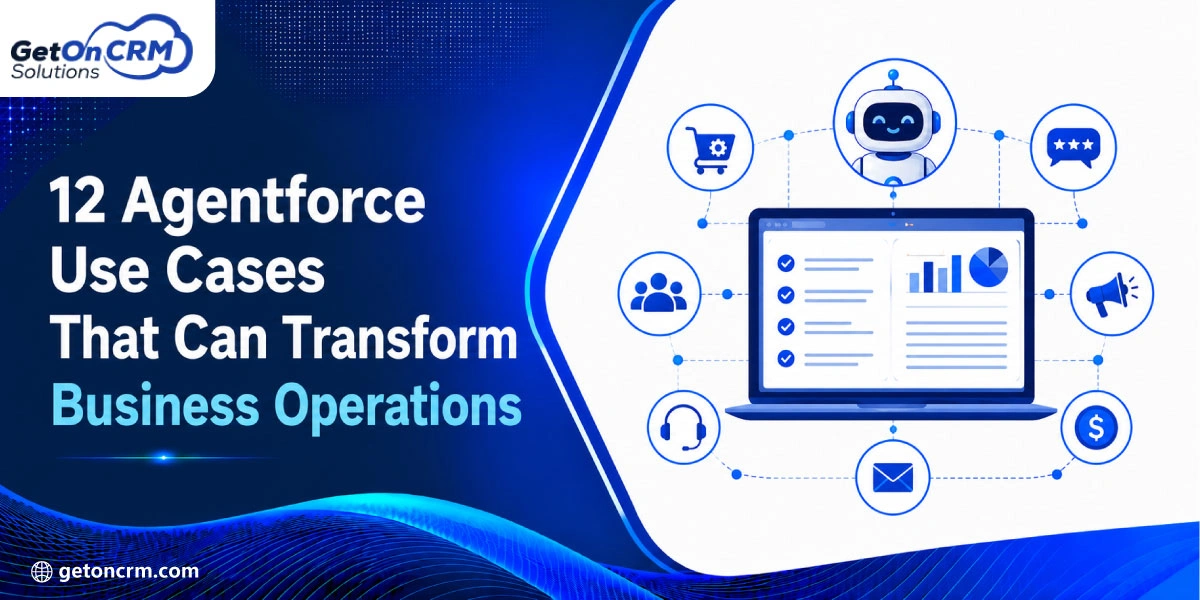
12 Agentforce Use Cases for Modern Businesses
1. Automated Customer Service
By managing frequently asked questions and routine support requests without the need for human intervention, Agentforce can automate customer service. It can offer clients immediate support through a variety of channels, assisting companies in providing reliable, round-the-clock assistance.
Based on business data and configured workflows, Salesforce Agentforce consulting is able to comprehend customer requests, find relevant data, and deliver precise responses. It can intelligently transfer cases to human service representatives for complex issues. This maintains a smooth and customized customer experience while lowering support workloads. It speeds up response times and frees up service teams to concentrate on higher-value customer interactions.
2. Intelligent Case Management
By automatically classifying, prioritizing, and navigating customer support cases, Agentforce can improve case management efficiency. It can evaluate case details, comprehend client needs, and identify which teams or representatives are most qualified to deal with particular problems. Using customer data, past interactions, and available knowledge resources, Agentforce can also suggest appropriate solutions.
It can produce brief overviews of prior discussions and crucial case details before representatives start working on a case. This facilitates a quicker understanding of customer needs, shorter resolution times, less manual administrative work, and more consistent support experiences for service teams.
3. AI-Powered Lead Qualification
By analyzing incoming leads and assessing their engagement, interests, interactions, and potential business value, Agentforce may streamline the lead qualification process. Agentforce can identify prospects with higher purchase intent and prioritize them appropriately, saving sales representatives from having to manually review each lead.
It can evaluate customer data, interactions, and engagement signals to identify opportunities that need to be addressed right away. The relevant teams or sales representatives can then receive qualified leads automatically. This enhances response times, makes the lead management process more effective and data-driven, and frees up sales representatives to spend more time interacting with high-value prospects.
4. Automated Sales Prospecting
By assisting companies in identifying possible clients and starting early-stage engagement, Agentforce can support sales prospecting. In order to find prospects who fit certain sales criteria, it can analyze the customer and account data that is currently available. After that, Agentforce can help with initial outreach by creating customized messages based on the interests and past interactions of the customer.
By determining when prospects should be contacted again and assisting sales teams in maintaining regular communication, it can also support follow-up activities. Businesses can decrease manual labor, improve sales productivity, improve engagement, and free up representatives to concentrate on conversations by automating repetitive prospecting tasks.
5. Sales Representative Assistance
By giving sales representatives relevant data at every stage of the sales process, Agentforce can serve as an intelligent assistant. Agentforce use cases help representatives quickly prepare by summarizing customer accounts, opportunities, past interactions, and crucial business information. Based on customer behavior, opportunity status, and available data, Agentforce can suggest the next best course of action.
Additionally, it can create meeting briefs with crucial talking points, client information, and opportunity updates. Agentforce can assist in creating customized follow-up emails and sales responses following meetings. Sales representatives can dedicate more time to establishing connections by cutting down on administrative tasks and improving access to relevant data.
6. Opportunity and Pipeline Management
By regularly analyzing opportunity data and identifying possible hazards, Agentforce can assist sales teams in managing opportunities and maintaining healthier pipelines. It can identify opportunities that might need quick attention and identify changes in customer engagement. Additionally, Agentforce can suggest steps like scheduling follow-ups or interacting with particular stakeholders that could advance deals.
Companies that use Agentforce consultancy can further tailor these features to their business needs and sales procedures. Agentforce helps sales teams make well-informed decisions, minimize opportunity leakage, and sustain more robust revenue forecasts by improving pipeline visibility and offering actionable insights.
7. Marketing Campaign Personalization
By analyzing consumer behavior, preferences, interactions, and engagement patterns, Agentforce can assist marketing teams in developing more tailored campaigns. Businesses can use Agentforce to support more relevant audience segmentation and communication rather than sending the same messages to every customer.
Depending on the needs and interests of each individual customer, it can suggest appropriate offers, content, and messaging. Additionally, Agentforce can assist marketing teams in adapting to shifting consumer behavior and identifying chances for more focused interaction. This level of customization can increase engagement, campaign relevance, and improve customer relationships.
8. Customer Onboarding Automation
By assisting clients and guiding them through the necessary steps, Agentforce can streamline the onboarding process. It can clarify processes, provide answers to frequently asked onboarding questions, and assist clients in understanding what data or paperwork is needed. Additionally, when certain onboarding tasks are finished, Agentforce can gather relevant data and initiate tasks for internal teams.
This helps companies maintain consistent onboarding procedures and lessens the need for customers to contact support teams on a regular basis. Agentforce can shorten onboarding cycles, lower administrative workloads, and increase customer satisfaction. It provides a more seamless transition from purchase to successful product adoption by automating repetitive tasks and offering guidance.
9. Commerce and Product Recommendations
By assisting clients in finding goods that fit their requirements, tastes, and purchasing habits, Agentforce can improve online shopping experiences. It can respond to inquiries about products, offer relevant data, and suggest appropriate products based on client needs. Agentforce can help consumers with routine purchase-related queries, product comparisons, and availability inquiries throughout the purchasing process.
This makes shopping more engaging and customized without necessitating ongoing help from sales or customer service agents. These capabilities can be used by businesses to improve product discovery, customer engagement, assist with purchasing decisions, and develop more convenient digital commerce experiences across customer touchpoints.
10. Order and Account Management
By automating a number of standard order and account management tasks, Agentforce allows clients to get help more quickly without relying solely on support agents. It can help customers with routine requests, respond to frequently asked account-related questions, and provide order status updates.
By obtaining suitable account data and assisting clients with available procedures, Agentforce can also assist with billing-related inquiries. It can escalate a request to the relevant support team when human intervention is necessary. Businesses can lower support volumes, improve response times, operational efficiency, and offer clients convenient self-service experiences.
11. Employee Support and Internal Operations
Agentforce can assist staff members by giving them rapid access to company resources, policies, and internal data. Instead of manually searching through numerous systems or contacting various departments, employees can use AI-powered assistance to find answers to common questions. Additionally, Agentforce can support workflows in the HR, IT, finance, and operations departments by automating administrative tasks.
Employees can, for instance, submit routine requests, obtain relevant data through conversational interactions, or receive guidance regarding internal procedures. Agentforce can increase worker productivity, streamline operations, and free up internal teams to concentrate on more challenging tasks by eliminating repetitive internal support tasks.
12. Revenue Operations Automation
By facilitating quoting, pricing, renewals, upselling, and other revenue-related workflows, Agentforce can assist companies in automating revenue operations. It can help sales teams find possible renewal or expansion opportunities and provide relevant data during pricing and quoting activities. Additionally, Agentforce can automate follow-up tasks, ensuring that crucial revenue-related tasks are finished on schedule.
It can improve coordination and close process gaps by integrating information between the customer success, finance, and sales teams. These features assist companies in developing more effective revenue workflows, improving team visibility, and supporting more consistent execution across the customer lifecycle.
Agentforce Use Cases by Business Function
⮞ Sales
Sales teams can receive assistance from Agentforce at various phases of the sales lifecycle. It can help representatives prioritize high-value prospects by analyzing incoming leads and evaluating their engagement and purchase intent. Salesforce Agentforce use cases can help with prospecting by identifying possible clients, supporting prompt follow-ups, and helping with tailored outreach.
Additionally, it can track opportunities, draw attention to possible hazards, and suggest the best course of action. Sales representatives can generate follow-up communications, create meeting briefs, retrieve relevant customer data, and summarize accounts using Agentforce. Agentforce helps sales teams increase productivity, speed up deal progression, and concentrate on developing better customer relationships.
⮞ Customer Service
By automating repetitive support tasks and helping service agents with challenging cases, Agentforce can revolutionize customer service operations. By offering prompt responses based on relevant business data and knowledge resources, it can assist in resolving typical customer problems. Additionally, Agentforce can classify and assign cases to the proper teams, ensuring that client requests are promptly handled by the appropriate representatives.
Customers can interact with AI-powered agents for self-service to find information, check updates, and fix common problems without having to wait for human help. These features can decrease support workloads, speed up response times, improve service effectiveness, and give clients consistent support through various channels.
⮞ Marketing
Marketing teams can provide more tailored and relevant customer experiences with the help of Agentforce. In order to facilitate audience personalization and targeted communication, it can analyze consumer data, behavior, preferences, and engagement patterns. Agentforce can help marketing teams with repetitive tasks like customer segmentation, content recommendations, and campaign planning.
Based on the interests and interactions of various customer groups, it can also assist in identifying relevant messages, offers, or content. Agentforce can help marketers improve customer interactions and campaign relevance by facilitating more customized engagement. This makes it possible for marketing teams to increase customer engagement throughout the customer journey, decrease manual labor, and better respond to customer needs.
⮞ Commerce
By supporting clients during the entire purchasing process, Agentforce can improve digital commerce experiences. By learning about their needs, preferences, and past interactions, it can assist customers in finding appropriate products. In addition to answering inquiries about features, availability, cost, and other product details, Agentforce can offer tailored product recommendations.
Additionally, it can help customers with order-related queries, such as tracking information and FAQ about purchases. Businesses may improve product discovery and lower friction during the purchasing process by offering conversational support. In the end, Agentforce can assist commerce teams in developing more individualized experiences and improving customer engagement. It assists with purchase decisions and increases client success rate.
⮞ Internal Operations
By assisting staff members with information access, routine tasks, and business process navigation, Agentforce can improve internal operations. Without relying on several departments, employees can use AI-powered agents to access relevant resources, retrieve information from organizational knowledge sources, and find answers to questions about internal policies.
Additionally, teams can manage repetitive administrative tasks and initiate actions across business systems by using Agentforce to automate routine workflows. These features can lessen manual labor while supporting departments like operations, finance, IT, and human resources. Employee routine needs can be resolved more quickly with Agentforce’s improved knowledge access and workflow efficiency, freeing up internal teams to concentrate on more strategic tasks.
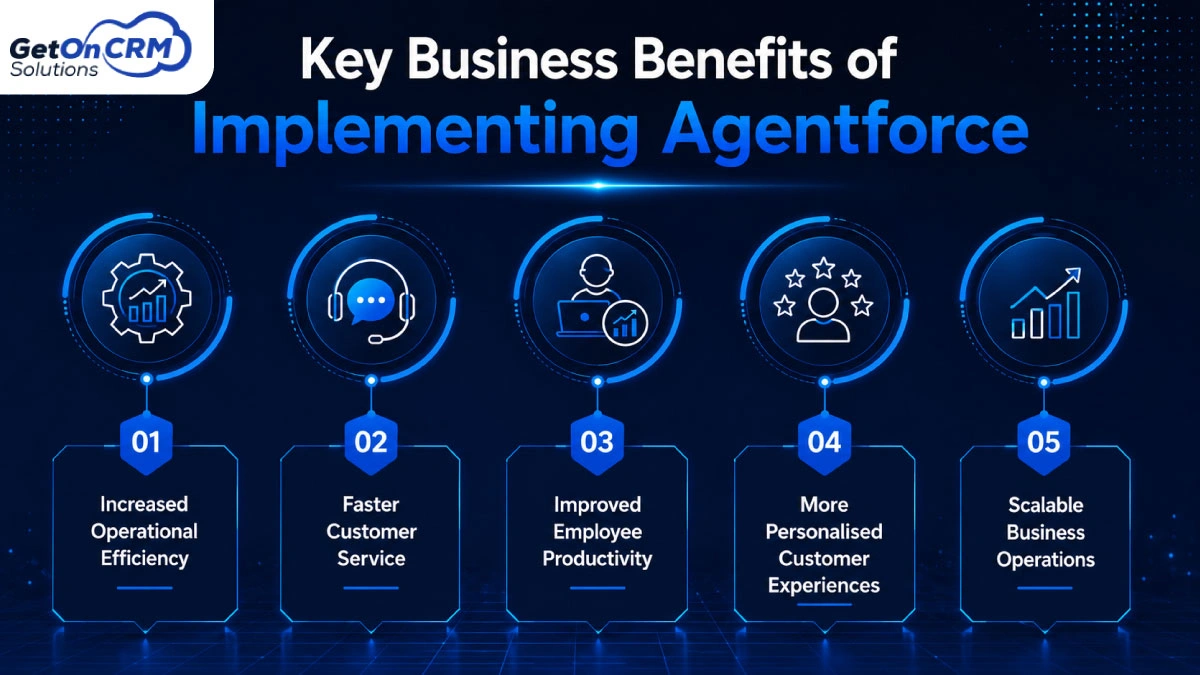
Key Business Benefits of Implementing Agentforce
⮚ Increased Operational Efficiency
Agentforce automates regular, high-volume processes to help businesses cut down on repetitive manual labor. With minimal support from humans, it can manage cases, retrieve information, interact with customers, and coordinate workflow. Businesses can lessen operational barriers, improve process consistency, and reduce administrative workloads. It enables teams to focus on strategic responsibilities by simplifying these tasks.
⮚ Faster Customer Service
Businesses can give clients immediate answers to faq and routine service requests thanks to Agentforce. It can speed up problem-solving, automate case management, and escalate complicated requests when human intervention is necessary. By investing in Agentforce consulting services, businesses can further optimize workflows to lower resolution times, increase service effectiveness, and provide more responsive customer experiences.
⮚ Improved Employee Productivity
Agentforce offers AI-powered support to staff members right within their current workflows. Teams can use it to retrieve information, summarize data, automate repetitive tasks, and suggest relevant next steps. Employees can focus on higher-value duties, make decisions more quickly, increase productivity, and contribute more successfully to strategic business goals by cutting down on time spent on difficult administrative tasks.
⮚ More Personalized Customer Experiences
Salesforce agentforce consulting services can provide more tailored and relevant interactions by utilizing customer and CRM data. It can offer recommendations and responses that are context-aware by knowing the customer’s history, preferences, behavior, and past conversations. This makes it possible for companies to deliver interactions that are in line with the needs of specific customers, build stronger relationships, increase engagement, and create more meaningful customer experiences.
⮚ Scalable Business Operations
Businesses can manage increasing workloads with Agentforce without having to increase manual labor. With consistent performance, AI agents can manage growing numbers of customer requests, internal tasks, and business processes. As their needs change, businesses can also increase automation across departments. This scalability allows for organizational adaptation, improves resource utilization, and supports operational growth.
How to Identify the Right Agentforce Use Cases for Your Business
⮞ Identify Repetitive Processes
Start with monitoring repetitive, high-volume activities that demand significant employee involvement. Look for activities such as answering basic common queries, updating records, routing requests, generating summaries, or performing routine follow-ups. Prioritizing processes that consume employee time can reveal strong opportunities for Agentforce automation. It must allow the team to improve efficiency while reducing manual operations.
⮞ Evaluate Your Salesforce Data
Measure the accessibility, quality, and consistency of Salesforce data before implementing use cases for Agentforce. Identify which account, case, customer, opportunity, and business data AI agents will require to perform their tasks effectively. Reliable and well-organized data allows Agentforce to deliver accurate responses, recommendations, and automated actions across business workflows.
⮞ Prioritize High-Impact Use Cases
Prioritize the best use cases for Agentforce that can deliver measurable business value. Focus on customer-facing processes that improve service experiences, revenue-generating activities that support sales growth, and operational errors that create delays and unnecessary workloads. Determine potential impact, implementation challenges, and business priorities to allow the firm to select use cases that offer valuable returns.
⮞ Define Clear Success Metrics
Determine measurable success metrics before implementing an Agentforce use case. Based on the workflow, firms can measure productivity, responses and resolution time, user satisfaction, operational cost reductions, and conversion rates. Clear metrics make it easy to determine performance, identify opportunities, demonstrate business value, and determine whether Agentforce automation is delivering the expected outcomes.
Best Practices for Successful Agentforce Implementation
⮚ Start with clearly defined use cases
Start by identifying specific business processes where Agentforce can deliver measurable value. Prioritize high-volume, repetitive tasks with clear goals. Well-defined use cases make implementation more focused, streamline performance measurement, and improve chances of successful adoption.
⮚ Establish strong data governance
Ensure Agentforce has access to accurate, secure, and relevant Salesforce data. Establish clear data governance policies that include access, quality, consistency, and privacy. Reliable data allows agents to generate more accurate responses, recommendations, and actions across various business workflows.
⮚ Define agent actions and boundaries
Clearly define the capabilities and limitations of Agentforce agents in each business process. Specify approved actions, access restrictions, approval points, and escalation requirements. Clear boundaries reduce mistakes, safeguard private data, and guarantee that agents follow company guidelines.
⮚ Integrate Agentforce with existing Salesforce workflows
Integrate Agentforce with current Salesforce apps, workflows, and business procedures. Agents can access accurate data and take the necessary actions when there is proper integration. Salesforce Agentforce consulting services facilitate more efficient operations and minimize needless manual intervention among linked teams.
⮚ Maintain human oversight for critical processes
Critical workflows involving complex choices, financial transactions, or substantial customer impact should continue to include human oversight. Establish explicit escalation procedures to lower possible operational risks, increase accountability, and offer more control.
⮚ Test agents before enterprise-wide deployment
Before distributing Agentforce agents throughout the company, thoroughly test them. Analyze their behavior, accuracy, security, integrations, and reactions in various contexts. Before extending deployment to more teams or processes, start with controlled pilot implementations, find problems, make the required changes, and verify performance.
⮚ Continuously monitor and optimize agent performance
After deployment, Agentforce performance should be continuously observed. Monitor metrics like accuracy, response times, and resolution rates. To guarantee that agents continue to produce reliable results, analyze performance data on a regular basis, find gaps, update configurations, and improve workflows.
Also Read: Agentforce Implementation Process: Step By Step Guide for Decision Makers
Agentforce Implementation Challenges to Consider
⮞ Data Quality and Accessibility
Agentforce relies on reliable & accessible data to deliver accurate results. Unorganized customer data across systems can limit an AI agent’s ability to understand contexts. Outdated, incomplete, and inconsistent CRM records may hamper recommendations. Organizations must improve data quality, establish data standards, and ensure data is accessible.
⮞ Security and Governance
Security & governance are crucial when releasing Agentforce across the organization’s processes. Businesses must carefully manage user permissions and control accessibility to crucial customer and business data. They must also establish clear AI governance policies covering data access, monitoring, usage, compliance, and accountability. Strong governance supports firms in using AI responsibly while reducing security and operational challenges.
⮞ Integration Complexity
Integrating with Salesforce apps, 3rd party platforms, and current business workflows can cause technical errors. Organizations may need to connect various systems, configure data flows, and ensure agents can access the data required for their tasks. Careful integration planning and QA are necessary to manage reliable workflows, limit disruptions, and ensure seamless communication between systems.
⮞ Change Management
Successful Agentforce adoption demands effective change management across the firm. Employees may need to adapt to new AI-driven workflows, processes, and responsibilities. Organizations should offer appropriate training, communicate benefits, and address employee concerns about automation. Strong adoption strategies allow teams to build confidence, use Agentforce effectively, and achieve better value from implementations.
Ready to Transform Business Operations with Agentforce?
Agentforce can assist firms in automating high-impact processes, improving productivity, and delivering smarter customer and employee experiences through smart AI agents. With the ideal approaches, organizations can scale Agentforce across departments while managing security, governance, and human oversight.
Salesforce Agentforce consulting can offer professional guidance for identifying use cases, configuring agents, integrating workloads, and optimizing performance. The best consultation team helps businesses maximize the value of AI-driven automation and achieve sustainable growth.