
Salesforce statistics offer a clear picture of how businesses are managing customer relationships. They reveal what’s working, evolving user needs, market trends, and where the industry is headed next. As competition increases, many companies are choosing Salesforce consulting services to improve performance by making smart investments. As Salesforce platforms evolve beyond traditional customer management, they are becoming AI-driven business platforms that support sales, service, analytics, marketing, and automation.
Salesforce continues to maintain a strong position in the CRM market by expanding its focus on AI-driven capabilities and advanced business solutions. According to Salesforce, 70% of companies using CRM platforms are exploring or adopting AI-powered capabilities to improve productivity and customer engagement. For organizations planning for Salesforce investment, these trends by Salesforce CRM solutions consulting can help guide decisions, identify emerging opportunities, and achieve long-term digital transformation.
Why Salesforce Statistics Matter in 2026
Salesforce statistics allow businesses to understand the platform’s growth, rising CRM trends, and accelerate AI adoption across industries. These metrics reveal how businesses are leveraging Salesforce to improve sales performance, streamline customer service, and improve overall productivity through advanced automation. The statistics highlight where the real opportunities lie with Agentforce, Data Cloud, and advanced automation tools reshaping daily operations. Staying aware of these trends allows businesses to make data-driven decisions and stay competitive in the AI business landscape.

Salesforce Market Share & Growth Statistics
1. Salesforce CRM Market Share Statistics
• The latest IDC’s semiannual software tracker gives a brief analysis of market share trends that influence the current and future of the software industry. The salesforce crm statistics show it holds a 20% share of the worldwide CRM market, positioned as the world’s leading CRM provider.
• Salesforce’s market share slipped slightly from 20.7% in 2024 to 20% in 2025, whereas Oracle has overtaken it and become its competitor with 4.1% market share.
• It marks Salesforce’s 13th consecutive year as the leader in the CRM market.
• Even after this, Salesforce generates 4 times the CRM revenue.
• Regionally it holds the #1 position in North, Latin America, Western Europe and Asia pacific countries, establishing its global dominance across major CRM markets.
2. Salesforce Revenue Growth Statistics
• In fiscal year 2026, Salesforce crossed $41.5 billion in annual revenue, broadening its AI platforms to over 29,000 customers.
• The growth was driven largely by its core subscription business representing the vast majority of the company’s total revenue and grew at a double-digit rate during the year.
• Agentforce and Data Cloud frequently become the fastest-expanding contributors in the market.
• There is an increase of approx. 10%, a record all-time high for the platform.
• In the future, Salesforce revenue will reach between $45.8 billion and $46.2 billion by the year 2027, reflecting 10-11% growth.
Also Read: A Complete List of Salesforce Consulting Services Every Business Needs
Salesforce Customer Adoption Statistics
3. Salesforce Customer Base Statistics
• As of 2026, over 1lakh 50 thousand companies are globally using Salesforce CRM. These statistics show it has one of the broadest customer bases in enterprise software.
• It reflects the dominance of Salesforce CRM as the world’s largest enterprise. 49% of salesforce users are from small businesses, 40% from mid-market and 11% are from large enterprises.
• It includes more than 90% of Fortune 500 companies, SMBs, and Startups across 100+ countries.
• The customer base has grown slowly since the Salesforce release in 1999. It has evolved from a niche sales tool to a full business platform.
• The vast ecosystem, salesforce certification statistics and skilled developers, are the reasons why more customers are choosing this platform for their company.
4. Salesforce Industry Adoption Statistics
• Adoption is expanding far beyond typical sales use cases, as shown by Salesforce’s industry-specific clouds. salesforce healthcare statistics shows 33% improvement in patient response times. It shows a roughly 29% reduction in operational expenses in the healthcare industry, indicating significant progress in care coordination.
• Financial Services Cloud is used by financial management companies and salesforce consulting partners. It is used to help with compliance-driven personalization, automate loan processing, and unify customer data.
• Manufacturing Cloud assists industrial enterprises in integrating sales, production, and planning on a single platform.
• The Retail Cloud allows unified commerce and customized shopping experiences for consumer brands.
• Technology firms, on the other hand, continue to be among Salesforce’s first and biggest users. It is used as the platform to manage complex, high-volume client and partner relationships at scale.
Salesforce Sales Cloud Statistics
5. Salesforce Sales Automation Statistics
Salesforce Sales Cloud statistics confirm that it remains one of Salesforce’s most widely used products. Companies across industries use it to streamline sales operations, manage customer relationships, and improve sales performance. For businesses looking to get more from the platform, Salesforce CRM consulting services can also provide guidance on implementation, customization, and ongoing optimization.
• Businesses that use Sales Cloud to manage contacts and sales activity saw a 29% improvement in success rates, according to Salesforce’s statistics. This gives sales teams a measurable advantage in closing agreements.
• Organizations report a 32% increase in productivity as automation eliminates complicated administrative responsibilities and manual data entry from sellers’ workflows.
• Since automated lead tracking and scoring assist representatives in prioritizing the prospects most likely to close, lead conversion also improves.
Forecasting becomes 44% more accurate, which gives executives more confidence in revenue planning and is beneficial for leadership.
• Sales executives can see transaction phases, risks, and opportunities for their entire team clearly when they use real-time pipeline dashboards.
Salesforce Customer Service Statistics
6. Service Cloud & Customer Experience Statistics
• Salesforce service cloud statistics show it has become key to how organizations manage support, with adoption broadening across contact centers and self-service portals across industries.
• Automation is a key factor in this change; since 2020, the use of AI in customer support has increased by 82%, according to State of Service research. This is because of businesses’ reliance on free agents for difficult issues and automated procedures to handle regular instances.
• Approximately 80% of consumers who have used AI-powered services report having a satisfied experience, and many now prefer a quick chatbot over waiting for a human agent.
• AI chatbots play a significant role in this trend. By eliminating the need for clients to wait in line, these automated solutions can reduce response times by as much as 50%.
• Salesforce customer service statistics represents almost 90% of customers believe that a company’s experience is just as important as its services, this improves customer happiness and loyalty.
Salesforce Marketing Cloud Statistics
7. Marketing Automation Statistics
• Over 4,000 business clients worldwide rely on Salesforce Marketing Cloud to manage billions of messages every day via email, SMS, and advertising platforms.
• Thanks to AI-powered personalization across channels and touchpoints, businesses that use Marketing Cloud claim a 34% increase in customer lifetime value.
• When segmentation, personalization, and automation are set up correctly, automated email campaigns can generate $10–$36 in returns for every dollar spent.
• Journey Builder automates multi-channel customer journeys and instantly improves messaging based on online, mobile, and email behavior.
• Using CRM-connected data, Salesforce predicts a 27% decrease in acquisition expenses and a 37% improvement in marketing ROI.
Salesforce AI & Agentforce Statistics in 2026
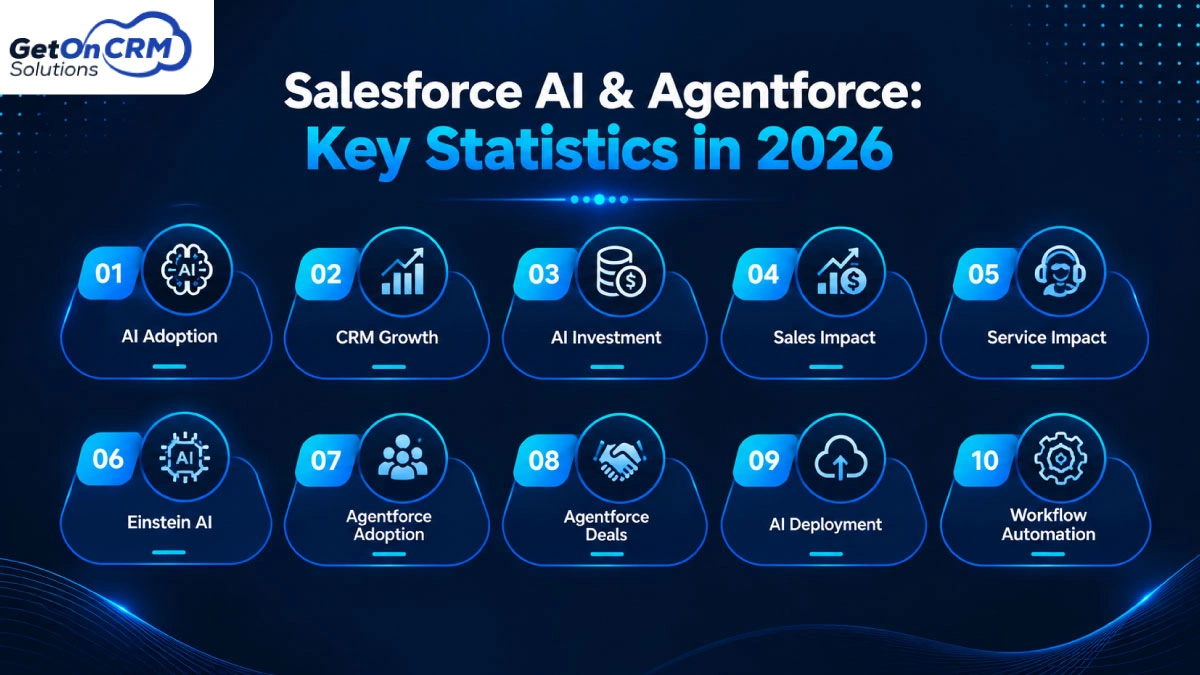
8. Salesforce AI Adoption Statistics
• As per Salesforce’s 20206 reports, 87% of sales firms now use AI for prospecting, lead scoring, forecasting, and drafting emails.
• Agentforce has grown to over $800 million in annual recurring revenue and 29000 customer deals within its first year.
• The sales team considered AI and AI agents as their biggest growth key for 2026, with 94% of leaders saying agents are crucial for meeting demand.
• AI agents are expected to cut email drafting time by 36% and prospect research time by 34%, as it influences sales and customer service.
• 54% of Salesforce Sales Cloud customers have actively enabled Einstein Lead Scoring, embedding predictive AI directly into sales operations.
9. Agentforce Statistics Businesses Should Know
• Agentforce has been chosen by big enterprises involving Finnair, Saks, and SharkNinja, to scale operations without adding staff.
• Agentforce deal growth rose from 5,000 in Q4 FY25 to over 29,000 by Q4 FY26, reaching $800 million.
• Salesforce’s Agentforce 360 closed more than 22 thousand deals in a single quarter and processed 771 million Agentic work units.
• Salesforce’s portal manages more than a million conversations yearly through Agentforce, resolving 85% without human judgment.
• Reports by Salesforce said Agentforce agents contacted 1 lakh 30 thousand leads and developed 3,200 opportunities in 4 months at a single company.
Salesforce Data Cloud & Analytics Statistics
10. Salesforce Data Management Statistics
• Data cloud and AI annual recurring revenue reached approx $1.4 billion by Q3 fiscal 2026, rising 114% yearly.
• Almost 50% of Fortune 100 companies have reached salesforce’s Data Cloud and AI solutions to gather customer data.
• Gartner named Salesforce a Magic Quadrant leader for CDPs, with 76% of reference customers citing Data Cloud impacts on decision-making.
• Data cloud changes organizations from batch-driven data syncing to real-time activation, influencing rapid personalization and AI-driven workflows.
• Salesforce code statistics reveals its AppExchange Marketplace offers 5141+ apps, allowing businesses extensive 3rd-party integration and connectivity options for data.
Also Read: 15 Trusted Salesforce Consulting Companies in the UK (Edition 2026)
Salesforce Statistics by Business Impact
➥ How Salesforce Helps Businesses Increase Revenue
Salesforce supports businesses in improving revenue by allowing sales teams better visibility into leads, user interactions, and opportunities. The unification of sales activities makes it easy to monitor prospects and identify opportunities. Organizations can also use user data to improve targeting and deliver relevant offers to a specific audience. Automated operations reduce repetitive process, help the sales team. Real-time analytics and dashboards also allow faster decision-making by allowing managers access to current sales data. With the ideal approach and implementation, salesforce crm consultants allow firms to create connected and efficient revenue processes.
➥ How Salesforce Improves Customer Experience
Salesforce allows firms to create more personalized user journeys by bringing together customer data, interactions, and preferences. With Salesforce CRM consulting services, firms can align CRM processes with their user experience goals and better use customer data. Teams can respond faster by accessing relevant data without switching multiple systems. Enterprise salesforce consulting firm supports omnichannel engagement, helping businesses to connect with customers through multiple channels. Improved visibility also supports businesses in addressing issues, strengthening relationships, and supporting long-term lead generation.

Transform Your Business Growth With Salesforce Experts
Salesforce allows scalable business growth by connecting sales, customer data, service, and organizational processes on one platform. Its AI capabilities improve automation and help teams work efficiently. CRM consulting services salesforce align the platform with specific organizational requirements. Data Cloud allows smart, data-driven decisions by gathering data across systems. The Salesforce ecosystem also enables enterprise transformation, whereas expert implementation allows organizations to optimize processes, improve adoption, and improve return on Salesforce investment.