

Salesforce Marketing Cloud in 2025 delivers a new level of personalization powered by AI, real-time insights, and advanced automation. With the transition from Marketing Cloud Classic to Marketing Cloud Core, businesses now gain a unified platform for deeper customer engagement. The introduction of Einstein GPT for Marketing enables real-time content generation, predictive insights, and AI-driven recommendations, making campaigns more targeted than ever.
The AI-based Campaign Builder accelerates personalization by designing, testing, and optimizing journeys automatically across channels — including email, mobile, and Salesforce SMS marketing. From real-time customer engagement to behavioral targeting, these Salesforce Marketing Cloud features redefine how brands connect with audiences in healthcare, retail, and beyond.
The Top Features of Salesforce Marketing Cloud 2025
From AI-generated campaign content to real-time personalization that feels almost psychic, Salesforce Marketing Cloud has evolved into an all-in-one engagement engine. Here’s what makes it stand out in 2025 — beyond the usual “send emails faster” promise.
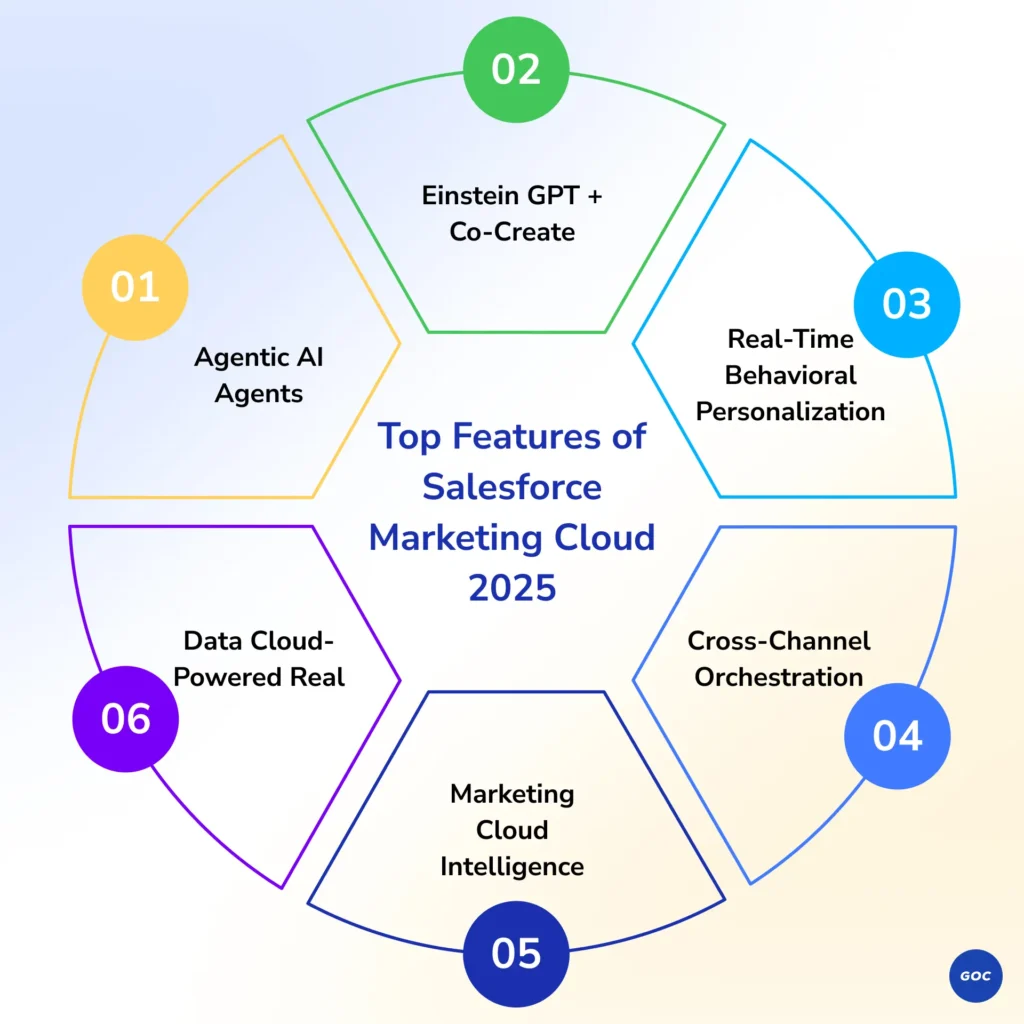
➥ Agentic AI Agents – Your 24/7 Campaign Managers
Think of them as tireless digital brand reps who never sleep. Agentforce integration in Marketing Cloud lets AI agents manage entire campaigns without you touching a button.
What it does:
Automatically updates offers, messaging, and sequences based on real-time audience behavior.
Handles inbound responses on SMS, WhatsApp, and email like a real support rep — instantly and in context.
Creates adaptive customer journeys that evolve mid-flight without a manual re-build.
Example: A healthcare campaign could reschedule an appointment reminder automatically when a patient replies “Can’t make it” via SMS.
➥ Einstein GPT + Co-Create – AI That Writes With You
This isn’t just “fill in a subject line.” Einstein GPT and Einstein Co-Create now help brainstorm, draft, and refine campaign assets inside Marketing Cloud.
What it does:
Suggests high-impact subject lines and pre-headers based on historical open rates.
Writes multiple email body versions and even generates HTML layouts.
Adjusts copy tone for different industries (B2B SaaS vs. healthcare outreach).
Integrates with AI-based campaign builder so the messaging fits perfectly with journey flows.
Example: Running a diabetes awareness campaign? The AI will adapt your tone to be empathetic, informative, and compliant — all in one draft.
➥ Real-Time Behavioral Personalization
The Marketing Cloud Personalization engine (formerly Evergage) is like having a one-to-one marketer for every customer.
What it does:
Analyzes every click, search, and scroll in milliseconds.
Recommends products, services, or content unique to each visitor.
Powers real-time customer engagement with Salesforce across web, app, and email.
Handles behavioral targeting so a returning customer sees different offers than a first-time visitor.
Example: A patient portal user who browses “heart health tips” may instantly get an email suggesting a free cardiology consultation.
➥ Cross-Channel Orchestration with Consent Intelligence
This is more than “multi-channel.” It’s context-aware, consent-aware orchestration.
What it does:
Syncs campaigns across email, SMS, WhatsApp, push notifications, and social in a single journey.
Tracks consent preferences in real-time — critical for Marketing Cloud for healthcare compliance.
Repeats, delays, or switches channels automatically if engagement drops.
Uses AI to predict the next best channel for each user.
Example: If a healthcare patient ignores email reminders, the system can automatically switch to SMS for better response rates.
➥ Marketing Cloud Intelligence – Data Storytelling at Scale
Raw numbers mean little until they tell a story. Marketing Cloud Intelligence turns data chaos into clear action.
What it does:
Combines campaign data from every channel into one live dashboard.
Identifies underperforming audience segments, then sends them into re-engagement journeys.
Predicts ROI for each campaign before launch using historical trends.
Shows Salesforce SMS marketing performance alongside email and web analytics.
Example: Spot that WhatsApp click-through rates are outperforming email? Double investment there instantly.
➥ Data Cloud-Powered Real-Time Engagement
The secret sauce: Salesforce Data Cloud fuels instant reactions to customer behavior.
What it does:
Activates a personalized response the second a user takes an action.
Uses unified customer profiles to keep messaging consistent across departments.
Allows “micro-moment” marketing — e.g., sending an offer right after a webinar ends.
Enables best features of Salesforce Marketing Cloud 2025 like predictive content triggers.
Example: A retail shopper abandons a cart — and gets an SMS with a discount code before they even close the browser tab.
Best Practices for Salesforce Marketing Cloud in 2025
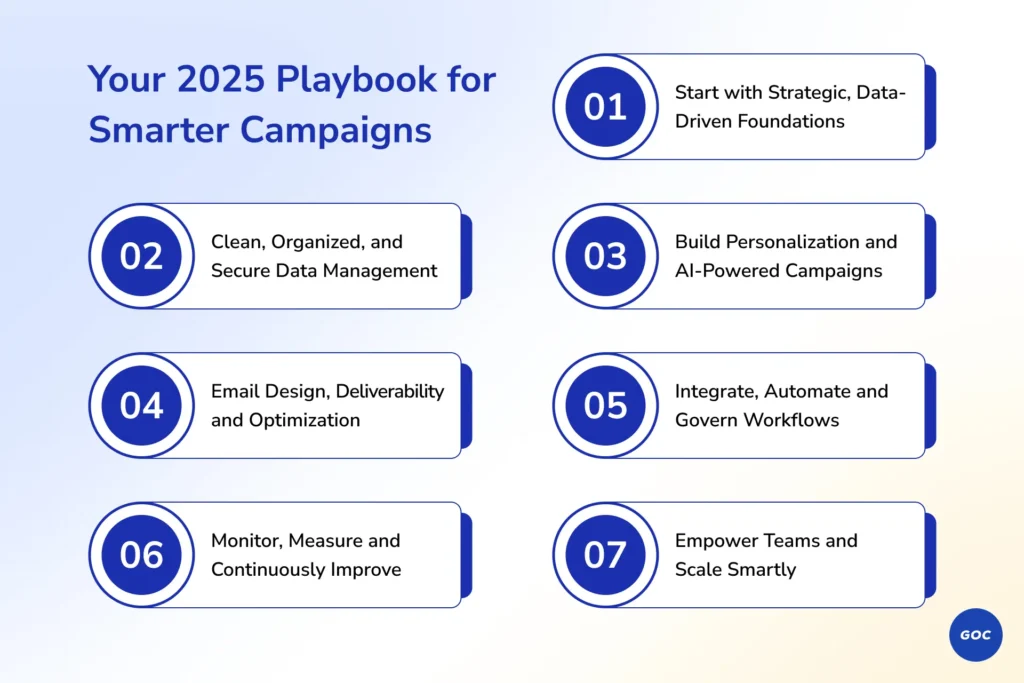
➥ Start with Strategic, Data-Driven Foundations
Define Clear Objectives & KPIs: Identify measurable goals—like increasing customer retention or enhancing engagement—and align them with tools like Email Studio or Journey Builder.
Plan & Phase Implementation: Engage stakeholders early, map system integrations, and execute in stages—setup, pilot, full rollout—with metrics for success.
➥ Clean, Organized, & Secure Data Management
Segment & Structure Data: Cleanse and organize data into segmentation-ready formats using Data Extensions versus static lists.
Optimize Performance: Limit use of Lookup functions in AMPscript, merge data into single sendable extensions, and test with realistic data—following code best practices.
➥ Build Personalization and AI-Powered Campaigns
Leverage Journey Builder: Craft multi-channel customer journeys personalized across email, SMS, social, and push.
Activate AI & Automation: Use Einstein GPT and Agentforce to deliver real-time predictions, content personalization, and smarter segmentation.
Enable Dynamic Content & Cross-Channel Personalization: Implement dynamic content blocks and integrate campaigns across channels for a seamless experience.
➥ Email Design, Deliverability & Optimization
Best Design Practices: Focus on readability with clean layout, consistent tone and branding across communications.
A/B Testing & Send Optimization: Experiment with subject lines, content, and timing; use automation and AI tools to determine the best times to send.
Ensure Inbox Placement: Monitor deliverability, avoid spam filters—clean lists, authenticate domains (SPF, DKIM), warm IPs, and validate email addresses.
➥ Integrate, Automate & Govern Workflows
Seamless Salesforce Integration: Link Marketing Cloud with Sales or Service Cloud via Marketing Cloud Connect for unified customer data.
Enable Automation Studio: Automate data imports, triggered sends, and routine workflows—especially beneficial in real-time marketing automation.
Govern Data Privacy: Use Data Retention Policies and Contact Delete workflows to remain compliant with GDPR, CCPA, and data privacy laws.Govern Data Privacy: Use Data Retention Policies and Contact Delete workflows to remain compliant with GDPR, CCPA, and data privacy laws.
➥ Monitor, Measure & Continuously Improve
Real-Time Analytics & Reporting: Track KPIs—open rates, conversion, engagement—in real time using built-in dashboards; leverage insights to optimize campaigns.
Use Automated Reporting Tools: For reporting at scale, use SQL in Automation Studio or Journey History API to fetch journey-level analytics.
➥ Empower Teams & Scale Smartly
Train Your Team: Invest in ongoing training to build expertise in SFMC tools and capabilities.
Plan for Scalability: Architect multi-business-unit setups strategically, with permissions, unsubscribe handling, and scalable governance.
Final Thought: Maximizing the Impact of Salesforce Marketing Cloud in 2025
Salesforce Marketing Cloud in 2025 offers unmatched opportunities for businesses to connect with customers through AI-driven personalization, real-time automation, and cross-channel strategies. By leveraging tools like Journey Builder, Einstein GPT, and dynamic content, brands can create impactful, data-driven campaigns that drive measurable results. The key lies in combining clean data management with smart automation for scalable growth.
Ready to harness the power of Salesforce Marketing Cloud?
Contact GetOnCRM to craft personalized strategies that deliver real business impact.
Frequently Asked Questions about Salesforce Marketing Cloud in 2025
What new features set the latest Marketing Cloud apart?
The updated Marketing Cloud includes advanced AI segmentation, real-time personalization, unified data modeling, and deeper automation—making campaigns smarter and more targeted.
How does AI segmentation improve marketing?
AI segmentation divides audiences dynamically based on behaviors, preferences, and predictive signals. Marketers can deliver more relevant content to each segment.
What is unified data modeling in the new Marketing Cloud?
It consolidates data from multiple sources into a single model. This ensures consistency across campaigns and better insight into customer behavior.
How has automation evolved in the latest version?
Automation in the new Marketing Cloud handles more complex triggers, cross-channel journeys, and adaptive workflows—reducing manual tasks while improving campaign agility.
Does the new Marketing Cloud improve cross-channel personalization?
Yes. It supports real-time personalization across email, mobile, web, and social channels—ensuring each customer sees relevant content regardless of platform.
Are there better analytics tools in the new version?
Yes. The upgraded platform offers deeper dashboards, predictive analytics, and AI-powered insights—helping marketers make data-driven decisions faster.