

Every click, lead, and customer interaction now feels different — Salesforce has refreshed its product lineup to simplify how businesses connect data, AI, and customer experience. As per Salesforce’s announcement, agentforce 360 is described as “the world’s first platform designed to connect humans and AI agents in one trusted system” .
This rebranding redefines how CRM users, consultants, and tech leaders identify, deploy, and manage Salesforce products. For mid-enterprise businesses, it’s a practical shift that impacts integration, licensing, and workflow alignment.
This article explains what’s changed, why it matters, and how to adapt your Salesforce strategy effectively.
What Is Salesforce’s Product Rebranding About?
Salesforce rebranding 2025 marks a significant change in the company’s product-naming and packaging strategy. In essence, older “Cloud” product names are being replaced with new names that reflect broader business outcomes, industry relevance, and AI-centric capabilities.
A key goal is to make it easier for business owners, CRM admins and tech leaders to understand what they are buying, how it fits their organisation, and how partner support options should align.
Why Did Salesforce Make These Updates?
Clarity and simplification: With a large, sometimes overlapping product portfolio, salesforce is aiming to cut through naming confusion and simplify decision-making.
AI integration and advanced capabilities: The rebranding signals that Salesforce’s evolution is not just cosmetic—it reflects deeper AI-driven, data-first products (such as Agentforce) embedded across sales, service, marketing and revenue workflows.
Customer and partner focus: By aligning names more tightly with business functions (e.g., Sales, Service, Revenue) and enabling easier mapping of solutions, Salesforce aims to help customers, partners and consultants speak the same language—including revisiting Salesforce partner support options under the new naming conventions.
Old vs New Salesforce Product Names (2025 Update)
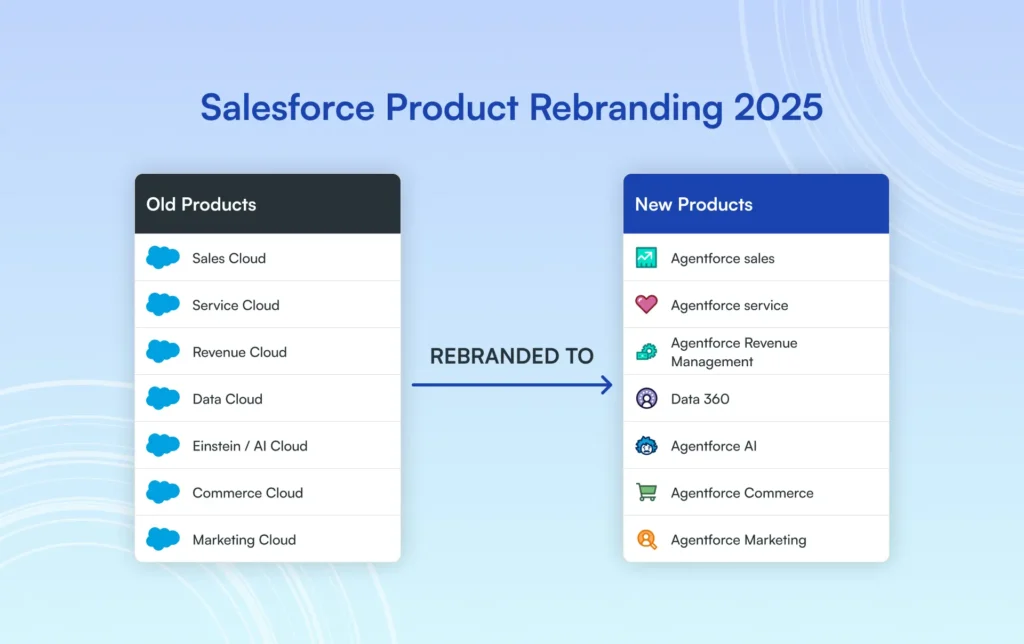
Here’s a representative table (for a mid-enterprise organisation in the USA) of how some key Salesforce product names are shifting. Use this as a reference when evaluating current licences, integrations, and partner alignments.
| Old Product Name | New Product Name (Rebranded) | Primary Function / Category |
|---|---|---|
| Sales Cloud | Agentforce sales | CRM for sales and revenue teams |
| Service Cloud | Agentforce service | Customer service & case management |
| Revenue Cloud | Agentforce Revenue Management | Quote-to-cash, billing, revenue opsQuote-to-cash, billing, revenue ops |
| Data Cloud | Data 360 | Unified data platform, CDP, analytics |
| Einstein / AI Cloud | Agentforce AI | Core AI engine and autonomous agent layer |
| Commerce Cloud | Agentforce Commerce | E-commerce and order management |
| Marketing Cloud | Agentforce Marketing | Marketing automation, engagement |
Note: These mappings reflect the direction of the rebranding effort. Some legacy names or transitions may still appear in documentation or partner materials.
Why Did Salesforce Rebrand Its Products?
Salesforce’s rebranding is part of its strategic vision to align product names with real business use cases and its growing AI ecosystem (including Agentforce and Data Cloud). The goal is to create a simplified, connected, and AI-driven experience across every Salesforce Cloud for customers, partners, and developers.
Key Reasons Behind the Rebranding:
Simplified Product Navigation: To make Salesforce’s suite easier for customers and partners to understand, reducing confusion between overlapping products and cloud services.
AI-Driven Alignment: To integrate Salesforce AI Cloud, Agentforce, and Data Cloud under a unified identity that clearly reflects the company’s AI-first direction.
Unified User Experience: To provide consistent naming, functionality, and navigation across Sales, Service, Marketing, and Commerce Clouds.
Business Outcome Focus: To shift focus from technical product categories to outcome-based solutions—helping businesses connect, automate, and grow efficiently.
Salesforce’s rebrand simplifies its ecosystem while positioning every product around intelligent, business-ready outcomes powered by AI.
What Does This Mean for Your Business to Rebranding Salesforce Producr Name? (Impact & Benefits)
Simplifying product naming and aligning features under one AI-powered ecosystem it helps organizations identify the right tools faster, improve licensing clarity, and unify customer, marketing, and service operations across all Salesforce platforms.
➥ Easier Onboarding and Product Discovery
Simplified product names help teams quickly identify what each Salesforce tool does. Instead of juggling multiple products like Sales Cloud + Einstein + AI Cloud, everything is now under Agentforce Sales—combining CRM and AI. Businesses save training time, accelerate setup, and onboard faster without confusion across departments.
➥ Clear Alignment Between AI, CRM, and Automation
The rebrand brings AI, CRM, and automation together through Agentforce, Data Cloud, and Einstein Copilot. This means fewer silos and smoother data flow between marketing, sales, and service teams. For example, insights from Agentforce can instantly personalize a customer email campaign managed within Salesforce Marketing—without additional integration steps.
➥ Better Licensing Transparency for Enterprise Clients
Licenses are now organized around business goals rather than product bundles. Instead of deciphering complex add-ons, clients see clear categories like Salesforce Sales or Salesforce Integration. This simplifies budgeting and purchasing. For instance, AI features are now part of core products—removing the need for separate “AI Cloud” licenses.
➥ Consistency in Data Experience Across Platforms
Every Salesforce product—from Salesforce Analytics (formerly Tableau) to Salesforce Integration (formerly MuleSoft)—now shares consistent interfaces and data models. This helps teams manage analytics, integration, and automation from one unified experience. For example, marketing and service dashboards can now pull customer insights from a single, shared Data Cloud.
Unsure how the Salesforce rebrand affects your system?
Schedule a consultation to assess your Salesforce setup, integration updates, and AI-readiness.
How to Adapt Your Salesforce Strategy Post-Rebrand
Stay ahead of Salesforce’s AI-driven shift by updating your org, training, and integrations to match the new product lineup.
Review Licenses & Subscriptions – Audit your current products to align contracts and functionality with Salesforce’s renamed suite.
Map Product Equivalents – Update internal docs and diagrams to reflect new names like Salesforce Sales and Salesforce Service.
Refresh Training Content – Revise onboarding and learning resources so teams understand the new AI-powered tools.
Check Integrations – Verify APIs and connected apps for old product references to keep systems synced.
Communicate Internally – Share updates across departments to ensure everyone speaks the same “Salesforce language.
A few smart updates today will help your business fully align with Salesforce’s new, AI-powered direction.
How Salesforce’s New AI Vision Fits Into This Rebranding
Salesforce centers AI with Agentforce, unifying generative AI across products.
➥ Agentforce (Unified AI Platform):
Acts as a co-pilot using Data Cloud for context-aware suggestions.
Enables prebuilt AI flows for faster deployment across teams.
➥ Einstein Copilot Embedded:
Sales: drafts emails, forecasts pipelines.
Service: triages tickets, suggests resolutions.
Marketing: proposes campaign ideas and segment insights.
➥ AI Cloud → Agentforce:
All AI capabilities (Einstein, Copilot, AI Cloud) now sit under Agentforce for centralized governance, simpler licensing, and consistent data security via Data Cloud.
➥ Quick old→new roundup:
Einstein GPT → Agentforce AI | AI Cloud → Agentforce Platform | Einstein Bots → Agentforce Copilot
Benefit for ICP: Simplified AI adoption, clearer ROI, and consistent cross-departmental automation—ideal for mid-enterprise CRM teams.
Need help mapping Agentforce to your org?
Expert Insights — What Businesses Should Do Next
Salesforce’s rebranding is the perfect time for businesses to reassess their CRM strategy and ensure alignment with its AI-first direction.
Review Your Roadmap: Map new product names to your workflows and integrations.
Adopt AI Tools: Explore Agentforce and Data Cloud for automation and analytics.
Check Licensing: Revisit contracts to match new bundles or editions.
Engage a Partner: Work with certified Salesforce experts for migration and AI enablement.
Pro Tip: Communicate naming and feature updates across teams to maintain CRM consistency.
Conclusion: Embracing the Next Era of Salesforce for Business Growth
Salesforce’s rebranding goes beyond new names—it represents a shift toward unified, AI-driven, and outcome-focused solutions. By simplifying products like Sales Cloud to Agentforce Sales, Salesforce makes it easier for businesses to identify value and drive efficiency.
Review your CRM setup, update training materials, and realign licensing to match the refreshed structure. With these steps, your organization can transform the rebrand into an opportunity—strengthening clarity, adoption, and long-term growth.
Ready to align your business with Salesforce’s new vision?
Our Salesforce-certified consultants help you map rebranded products, update integrations, and optimize licensing for your org.
Frequently Asked Questions About the Salesforce Rebranding
Is Salesforce rebranding going to affect existing customers?
No, functionality and contracts remain the same; it’s a naming update for clarity and branding consistency.
Will there be pricing changes due to the rebrand?
Salesforce has not announced pricing changes tied to rebranding, though future editions may align with new AI bundles.
Does the rebranding impact Salesforce Trailhead or certifications?
Yes, Salesforce will gradually reflect the new names in Trailhead modules and certification materials.
How does Agentforce relate to Salesforce AI Cloud?
Agentforce is the new umbrella term for Salesforce’s AI capabilities, merging Copilot, AI Cloud, and Einstein features.
What’s the difference between Salesforce Integration and MuleSoft?
MuleSoft now operates under Salesforce Integration to unify its branding and highlight its native connection to the Salesforce ecosystem.