
Salespersons have started embracing agentforce revenue management services as it provides an easy way to handle sales, pricing, contracts, and invoicing. However, before initiating the implementation process, understanding Salesforce Revenue Cloud implementation cost is essential as it not only helps to estimate the financial requirements of the business but also helps avoid unexpected expenditures. Being aware of Salesforce Revenue Cloud implementation cost makes it easier for the organization to decide upon the method of implementation.
The popularity of Salesforce Revenue Cloud continues in 2026, as it is an automated solution that not only saves time but also ensures revenue processes are accurate and streamlined from sales to billing and collections. According to Salesforce’s State of Sales report 83% of sales teams using AI reported revenue growth over the past year, highlighting the value of AI-powered revenue automation. However, implementation costs vary significantly depending on factors such as business size, customization requirements, integrations, and overall project complexity.
This article will cover in depth Revenue Cloud Implementation Cost, factors influencing it apart from hidden expenses to watch out for, and effective methods to keep the budget low but maximize long-term ROI.
What Is Salesforce Revenue Cloud?
⮞ Overview of Salesforce Revenue Cloud
Salesforce Revenue Cloud is a quote-to-cash (QTC) solution where all revenue-related functions are handled from a single location: pricing, quotes, agreements, billing, and renewals- see a few examples. It is meant to be a bridge that joins sales and finance and customer service as well. It helps streamline the whole revenue lifecycle and reduce manual work for the teams.
The platform automates a variety of key workflows, thereby significantly cutting down on human involvement, and at the same time it raises the level of accuracy. Businesses using Agentforce revenue management are able to do the job faster; their forecasting is on point; their ability to run subscriptions and manage all kinds of revenue is at the highest level.
The powerful Salesforce integration and AI-based features of Agentforce revenue management solutions provide businesses that deploy this with a competitive edge in the market and improve the customer experience simultaneously. In addition, many companies opt for Agentforce revenue management services in order to make their processes even smoother and at the same time make room for growth over the years.
How Much Does Salesforce Revenue Cloud Implementation Cost in 2026?
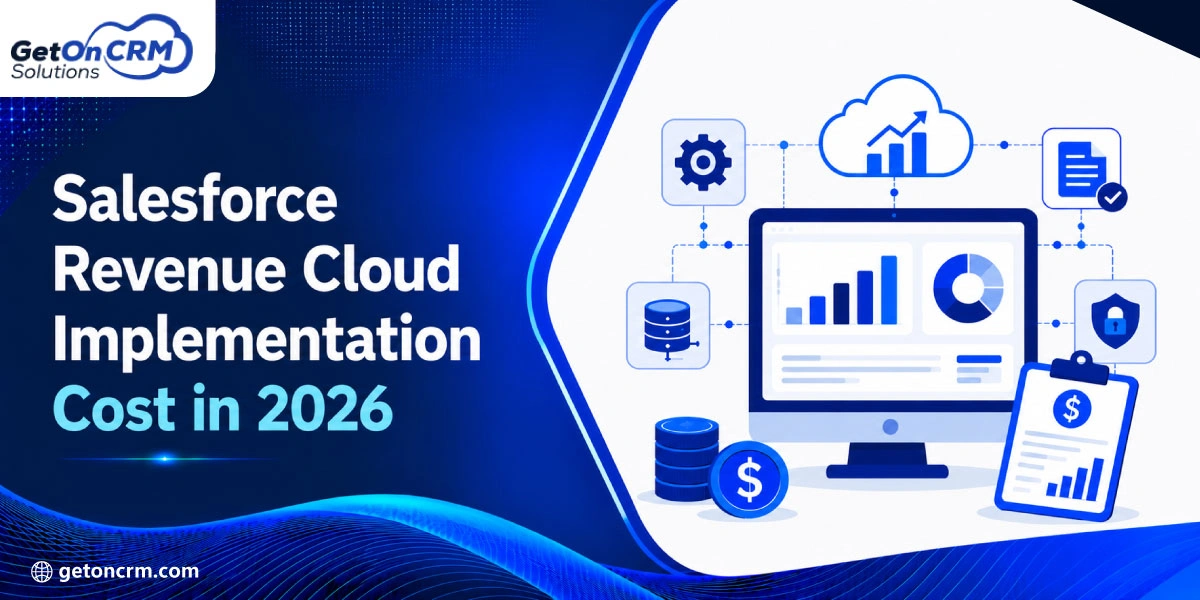
The sales of your Revenue Cloud Implementation for 2026 will be affected by several elements, such as your business size, level of customization work you need, how much system integration you’re going for, and so on. The average revenue cloud cost varies from small businesses spending about $20, 000 to $50, 000, mid-sized companies will need about $50, 000 to $150, 000 and large corporations around $150, 000 to $500, 000+ depending on the complexity level of your project.
Some projects may include ERP integrations, which could push the total implementation budget to about $750, 000. So, it is very important that you understand both the Salesforce Revenue Cloud cost and the Revenue Cloud price so as to prepare a proper budget for you, at least to an extent that it gives you an indication.
Most implementation costs include discovery, solution design, configuration, development, data migration, testing, deployment, training, and initial support. The final revenue cloud implementation price varies based on the project’s requirements. It is also important to separate software licensing costs from implementation services. Working with an experienced Agentforce revenue management partner helps businesses optimize costs and achieve a smoother implementation.
Also Read: Complete Salesforce CPQ to Revenue Cloud Migration Checklist
Salesforce Revenue Cloud Cost Breakdown
It is not only the purchase of software that is the main aspect when considering costs related to Revenue Cloud Implementation. It is equally important, or even more, that companies look into the other cost categories like licensing, consultant fees, data migration, integration expenses, training of the users, and also the cost of ongoing Maintenance. It is only after properly budgeting for the different cost factors that Revenue Cloud will be successfully implemented, and that will make up the total cost.
◈ Licensing Costs
Licensing is not just an expense; it’s one that keeps coming regularly. Depending on how many users access Salesforce, how many features are picked, and the Salesforce products used, it can change every now and then. Working with an experienced Agentforce revenue management partner helps businesses choose the right licenses without overspending.
◈ Consulting & Implementation
It is quite common for companies to spend more on the first phase of consulting and implementation services for the Revenue Cloud than any other phase. This is not just the time when business discovery, solution design, configuration, custom development, and, if the time allows, testing and deployment are carried out; consultants are also there to support you by making sure that everything is going well so that business processes are well aligned with the platform, and it is ready for daily activities.
◈ Data Migration Costs
Preparing for new systems by transferring, transforming, and loading data from old systems is quite a big task, but with careful planning, the validation of the data is not difficult at this stage.
New platform migration, including customers, products, sales, contracts, and subscription records, must be done very well so that data is clean and accurate, not only for implementation but also so that reports will be correct in case anything else that needs to refer to the data is made. Taking on data migration is worth it since it helps minimize the occurrence of errors, which will in fact lead to more accurate reporting later on.
◈ Integration Costs
As Revenue Cloud is a component of many businesses’ ecosystems, a large majority of businesses have integrated Revenue Cloud with existing systems such as, but not limited to, finance (ERP systems), accounting, sales force automation (SFA), marketing automation (MA), etc.
In order for these different systems to talk to each other, they need to be coupled through middleware or application programming interfaces (APIs) if available. Revenue cloud implementations using integration platforms like SAP, Oracle, or NetSuite will increase the cost of the implementation. As their main objective is to create revenue management ecosystems, many businesses choose agentforce revenue management solutions.
◈ User Training
One of the main aspects that can define whether a system will be accepted among the users is the level of training provided to them. For system administrators, it is about how to run the platform and maintain it. Sales teams are trained mainly in the usage of quote, opportunity, and contract processes, as these tools help them make the selling process more efficient.
The role of finance teams is about how they make the billing process as smooth as possible and also manage the various revenue streams. In other words, they deal with the revenue management activities of the company. These well-trained users get to be more productive, and as they have fewer problems, they are in a better position to contribute to the company’s operations.
◈ Ongoing Support & Maintenance
As with any enterprise application, it is normal for businesses to encounter some sort of issues from time to time. Therefore, it will be prudent for them to continue working with their Salesforce partner who has helped them with the Revenue Cloud deployment after implementation, so that their Revenue Cloud environment remains secure and performs optimally.
With the help of an agentforce revenue management partner after implementation and beyond, businesses can expect that their Revenue Cloud environment will not only be maintained and secured from cyber-attacks, but their processes will be optimized and aligned with the changing landscape of their business.
Factors That Affect Salesforce Revenue Cloud Implementation Cost
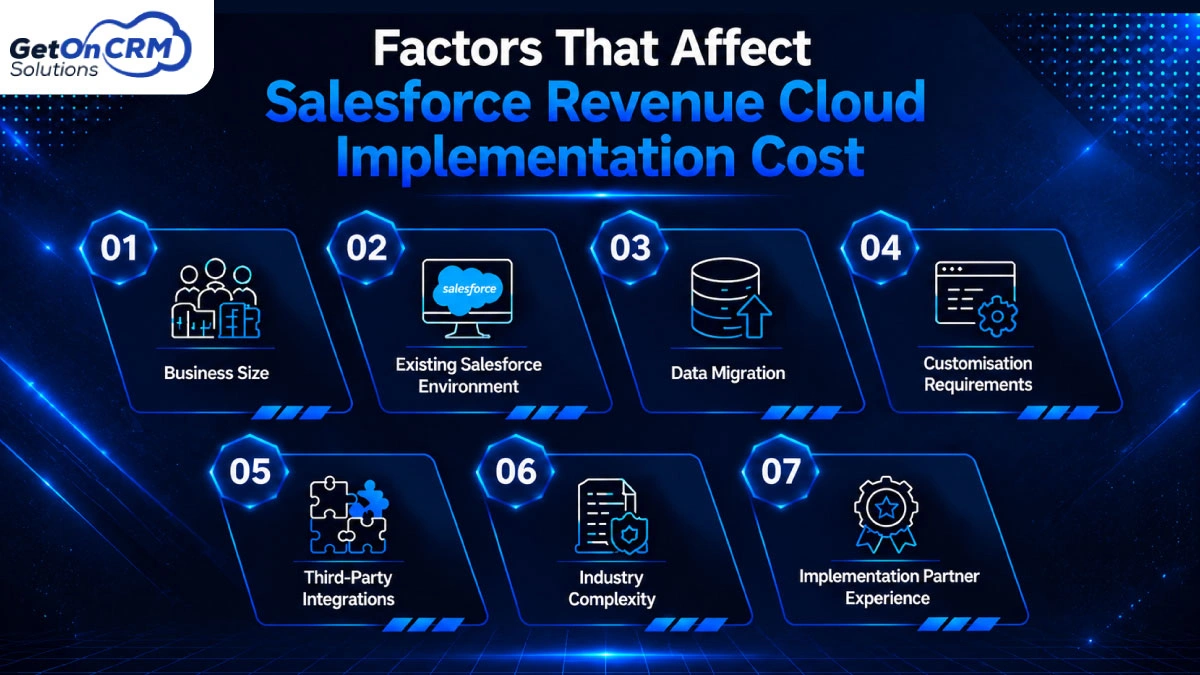
The revenue cloud implementation cost varies considerably from company to company mainly because of differences in the company processes and requirements. It is clear that factors like business size, legacy systems, existing data quality, system customization, integration, etc., will greatly determine an implementing company’s final budget. The following factors may also be taken into account in your cost estimation for the implementation of Revenue Cloud and they are the following:
⮞ Business Size
Business size is certainly going to be one of the main factors deciding implementation costs.
Large companies with many users need more system configuration, security settings, role and permission definition, extensive testing, and in-depth training. In large organizations with multiple departments, it would be customary to have individual workflows, separate approval processes, different pricing rules, varied reports, and dashboards. Multinational organizations are likely to face additional implementation challenges in the form of having to implement solutions supporting multiple languages, currencies, and tax regulations.
⮞ Existing Salesforce Environment
Your current Salesforce setup can affect both the timeline and cost of implementation. New Salesforce users typically require a complete setup, including configuration, user creation, and integrations. Businesses already using Salesforce CRM can often implement Revenue Cloud faster because much of the customer data and system configuration is already in place. However, replacing legacy systems usually involves additional migration work, custom integrations, and extensive testing.
⮞ Data Migration
If you’re going to migrate only high-quality data, it will also influence the final total of the project. The data types that the business deals with that need to be transferred to the Salesforce platform are customer, product, pricing, contract, subscription, and invoice records. The volume of outdated datasets to clean and check can increase Salesforce Revenue Cloud cost significantly.
⮞ Customization Requirements
Salesforce provides out-of-the-box several options to customize, but some other businesses have to create their own workflows and approval processes and configure CPQ, custom objects, and industry-specific automation if their standard features are not sufficient. The implementation cost and the revenue cloud implementation price will be higher the more customized you get it, as you need extra development and testing.
⮞ Third-Party Integrations
Multitudes of companies link Revenue Cloud to ERP systems, payment gateways, tax software, and customer support platforms. Integrating with SAP, Oracle, NetSuite, or Stripe usually requires planning, software development, testing, and maintenance as well, which can raise the overall implementation cost considerably.
⮞ Industry Complexity
Industries such as manufacturing, healthcare, SaaS, telecommunications, or financial services are often where requirements for sales and compliance procedures have sales teams going through a labyrinth of rules. Businesses may need more sophisticated approval workflows, compliance controls, and customized reporting. The overall Revenue Cloud Implementation Cost will increase with these features.
⮞ Implementation Partner Experience
Besides a lot of other things that make your implementation success dependent, the most underrated element is the experience of the partner who implements it for you. Highly-trained consultants not only understand the technology, but they also know proven ways of delivering these solutions, have better-planned projects, and can manage a project faster and more efficiently. Collaborating with an experienced Agentforce revenue management company is a great move toward risk mitigation, avoiding time-consuming changes, making sure that your solution is expandable and capable of driving business expansion in the years to come.
Hidden Costs Businesses Often Overlook
Many companies think about only licenses and consultants’ fees and don’t realize that there are other expenses as well that may change the total implementation budget.
◈ Common hidden expenses:
• Changes brought during implementation
• Additional Salesforce licenses purchase
• Including data cleaning efforts along with migration
• API usage limits
• Management of change initiatives
• In-house training programs
• Purchases from third-party software
• Cost for the development of custom reports
• Safety measures improvement
• Optimizing after-sales support
Getting ready early by identifying these costs may not only help the organization save a lot of money in the later stages but will also contribute towards the success of the implementation with the help of better preparation.
How to Reduce Salesforce Revenue Cloud Implementation Costs
Salesforce Revenue Cloud is a significant investment, but with thoughtful planning, a company can still control the overall expenses. Companies can actually reduce their expenses by concentrating on their business requirements, eliminating unnecessary work, and proceeding with a well-planned implementation strategy to keep the Revenue Cloud Implementation Cost at a minimum without affecting the quality of the system.
⮞ Define Clear Business Requirements
As the implementation of Revenue Cloud is an expensive process, the best approach at this stage is to clearly communicate the business goals, the business’ difficulties, and the expected results of this process and then start working towards the implementation. However, it still makes sense for you to have agentforce revenue management solutions to deal with your current business needs. If you concentrate on such issues as enhancing the efficiency of creating quotes, automating the approval process, simplifying contract management, improving billing accuracy, and the reporting features, you will have your priorities and budget better allocated.
⮞ Minimize Customization
Salesforce Revenue Cloud cost has various functionalities that are already embedded and cover the regular business requirements of companies. Utilizing the core features over customizing the platform helps to cut down the time needed for the implementation and also to do the testing and to maintain the system afterward. Therefore, limiting the number of customizations will help reduce the cost of Revenue Cloud Implementation and also facilitate the upgrading of the system at a later stage.
⮞ Clean Data Before Migration
Importing wrong or low-quality data can result in higher expenses and delays in implementing Salesforce Revenue Cloud. Remove duplicate entries, correct out-of-date customer data, check product catalogs, validate contracts, and standardize data. Data cleansing ensures that migrations are easier and faster to implement and reporting is better post-launch.
⮞ Implement in Phases
Introduce the features of Revenue Cloud gradually; don’t roll everything out at one time. First of all, launch the most essential features like quote management, product catalogs, pricing, and approvals. Later, include subscription features, billing, AI automation & advanced features of Revenue Cloud. A phased deployment method reduces the initial cost of Revenue Cloud implementation, lowers the risks of the project, and allows the end-users to gradually switch over to new software.
⮞ Choose an Experienced Salesforce Partner
You should work with a vendor who has a lot of experience in the field to avoid potential project delays. Certified consultants bring the know-how that enables effective deployment of the Salesforce system; their best practices are followed, which minimizes errors and time consumption, and the project team is expert in handling such situations that lead to timely and cost-effective delivery of the project. A partner who specializes in revenue management services of Agentforce and has great knowledge and understanding of the market also brings about a solution that is scalable to match future business demands.
⮞ Invest in User Training
Training users well on how to exploit all the features of the new Revenue Cloud system is an area that should be given enough attention. Different functions can be assigned to sales staff, finance staff, and administrators. All staff groups should be trained according to their roles. A well-developed user training program not only increases user familiarity with the system significantly but also lowers the number of support requests and thus contributes to better business results from the investment in an agentforce revenue management solution.
Also Read: AI-Driven Revenue Cloud Automation: The Next Frontier for Enterprises
Is Salesforce Revenue Cloud Worth the Investment?
For a multitude of enterprises, the Revenue Cloud by Salesforce is a powerful tool that, once implemented, offers the value of automation and cross-departmental transparency far surpassing the original project expenses. Companies that implement agentforce revenue management solutions regularly see a marked improvement in their sales processes, the accuracy of the financial reports, and the overall customer satisfaction levels.
◈ Benefits
🢥 Faster Quote Generation:
The system generates a quote on an automatic basis; hence, the sales representatives need not spend much time in the creation of a proposal. Quick delivery of a quote allows a company to catch up with a buyer’s request or even anticipate one and conclude the deal earlier.
🢥 Reduced Manual Work:
With automation, a huge variety of repetitive jobs from approvals, contract generation, and billing, etc. can be handled, thus enabling staff to take up important work.
🢥 Improved Revenue Visibility:
The system gives the executives up-to-the-minute information about the sales performance as it is going on, the details of contracts, subscriptions, and overall revenue trends. That is how the executives can plan and make decisions based on accurate information about revenue sources, their value, and when they are expected to come in.
🢥 Better Forecasting:
Thanks to AI-driven analytics and data aggregation, the sales teams and the business managers cannot just visualize data more clearly but can also accurately interpret what it means. As a result, companies get a good idea of where they are in the selling cycle and how much is in the pipeline, and that can help them plan better while the company is still in a growth period.
🢥 Higher Sales Productivity:
The representatives in sales are given less time for administrative work and more time to interact with customers to develop relationships and to close sales opportunities.
🢥 Scalable Operations:
Revenue Cloud allows you to add more users, products, markets, and business units as you grow your company without major system changes.
🢥 Increased Customer Satisfaction:
Accurate pricing, speedy approvals, simplified contracts, and smooth purchasing experiences lead to happier customers.
Businesses using a cloud agentforce revenue management solution commonly enhance their customer retention because of offering a buying path that is more uniform and reliable.
◈ ROI Considerations
Businesses that assess Revenue Cloud Implementation Cost should also look into the long-term return on investment.
🢥 Faster Sales Cycles: Around processes such as quote creation, approvals, contracts, and billing, automation eliminates delays to help a company win a sales opportunity faster.
🢥 Reduced Operational Costs: Using automated workflows saves time, reduces the chance of errors, and boosts employee performance.
🢥 Increased Revenue Accuracy: Accurate billing and centralized pricing rules not only reduce revenue leakage but also maintain a high level of financial accuracy.
🢥 Improved Compliance: Through standard approval workflows and audit trails, Revenue Cloud helps companies comply with internal guidelines and applicable laws.
Although the initial Salesforce Revenue Cloud cost may seem significant, many organizations recover their investment through increased efficiency, improved productivity, and stronger revenue management.
Ready to Estimate Your Salesforce Revenue Cloud Implementation Cost?
Different businesses with different scales of operations will require different features. Hence, the revenue cloud implementation cost will be different for you from one business to the next if your business size, customization, integration, data transfer, and difficulty levels of the project are different. Planning both for the initial implementation and the ongoing maintenance can help a company stay away from sudden expenses.
A more seamless installation and improved long-term outcomes are guaranteed when working with a seasoned Agentforce revenue management company. Understanding prices such as revenue cloud cost, Salesforce revenue cloud cost, revenue cloud price, and revenue cloud implementation price will lead to good business choices. The use of Agentforce revenue management services leads to fewer activities that interfere, a more accurate way of forecasting, and eventually, the building of a revenue management system that is very much ready for scaling up.