
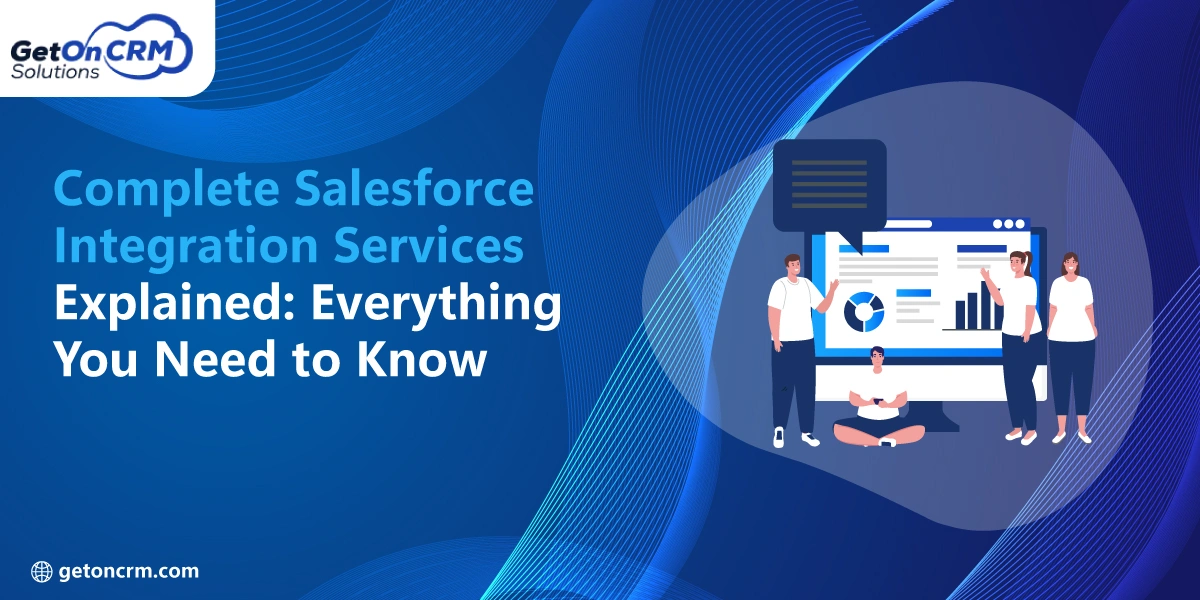
Are you still manually transferring data between CRM and other applications? If you are doing it in 2026, you are unknowingly stopping your own growth. In the current tech environment, a disconnected tech stack is a disadvantage. Salesforce is the world’s leading CRM platform, offering a wide range of features and functionalities to support businesses in simplifying their sales, marketing, and customer service processes. Most of the firms rely on other systems to manage various aspects of operations. Salesforce integration services enable these systems to connect and share data seamlessly, drive efficiency, and offer a holistic view of user interactions.
CRM adoption is evolving rapidly, with 91% of businesses using CRM systems to improve customer engagement and operational efficiency. This widespread adoption highlights the growing importance of platforms like Salesforce, known for its flexibility and seamless integration capabilities. If you are looking to close more deals, improve the efficiency of your sales funnel, and increase conversions, Salesforce Integration Services can be a valuable investment. Read the following blog to learn the fundamentals and advanced aspects of Salesforce integration.
What Are Salesforce Integration Services?
✦ Definition of Salesforce Integration
Professional Salesforce integration services solve the issues of fragmented data systems in firms. It guarantees an ideal interconnection between Salesforce and other apps that manage user data. Integration can occur in various ways, depending on the needs of the business.
Integration with Salesforce is necessary, especially for entities that seek to drive the use of CRM systems. When integrated with other systems, Salesforce creates effective processes, real-time data, and user insights. The following interconnections make the decision-building steps efficient. Salesforce CRM integration services allow multiple practices to connect Salesforce with existing solutions. It allows seamless data transfer and collaboration. Each type of integration caters to various requirements, complex levels, and desired outcomes.
✦ Why Salesforce Integrations Matter
🢧 Eliminate data silos
Salesforce API integration services support eliminating data silos by integrating CRM with other systems. When data flows seamlessly between systems, departments can access data in a unified source. It enhances collaboration, minimizes duplication, and ensures teamwork with the same data across firms.
🢧 Improve operational efficiency
Integrating Salesforce with business apps automates data sharing and limits the need for manual processes. Employees spend less time transferring data between systems and more time prioritizing strategic activities. Automated operation streamlines operations, minimizes errors, and enhances process consistency. Firms can enhance productivity, decision-making, and performance.
🢧 Enhance customer experience
Collaborating with a Salesforce integration company offers a unified view of user interactions by connecting data with sales, marketing, and other business systems. It enables the team to access relevant user data quickly and deliver a customized user experience. Enhanced visibility into user journeys allows firms to respond faster to inquiries, resolve errors efficiently, and build stronger user relationships.
🢧 Enable better reporting and analytics
By consolidating data from various business systems, the Salesforce integration solution enhances the accuracy and quality of reporting. Firms can access real-time data, track performance metrics, and obtain brief insights into business operations. Integrated reporting supports improved forecasting, strategic planning, and decision-making. Integrated reporting supports improved forecasting, strategic planning, and decision-making. It allows firms to identify opportunities, measure progress, and enhance operational performance.
Common Business Challenges Solved by Integration
✤ Manual data entry
This is a common challenge for a firm that uses various software apps without proper integration. Employees mostly spend time transferring information between systems, increasing the risk of errors, duplicate records, and outdated data. Salesforce integration solution allows automating data synchronization, ensuring data is upgraded across connected platforms in real time.
By limiting repetitive administrative tasks, firms can enhance efficiency and data accuracy and allow the team to focus on other activities. Automated CRM integration services support for maintaining consistency across departments while limiting operational errors caused by manual processes.
✤ Inconsistent customer records
When users’ data is stored across separate systems, organizations may face errors with duplicate or incomplete records. The lack of consistency can hamper user service, sales performance, and reporting accuracy. Integration supports synchronizing user information between Salesforce and other business apps, creating a unified and reliable data source.
With consistent records across departments, the team can access accurate user details, interaction histories, and transaction data. It enhances collaboration, supports improved decision-making, and allows firms to deliver personalized and seamless user experiences across all touchpoints.
✤ Delayed reporting
Organizations that rely on fragmented systems often face delays in crafting reports because data must be collected, consolidated, and validated manually. These delays can make it tough for decision-makers to access timely insights and respond quickly to changing business conditions. Salesforce integration services allow for streamlined reporting by automatically synchronizing data from various platforms into a centralized landscape.
It allows firms to generate accurate reports using real-time data. Quick accessibility to business insights drives forecasting, performance tracking, and strategic planning while supporting leaders to make valuable decisions based on current data.
✤ Disconnected workflows
Fragmented workflow occurs when an organization’s processes span various systems that don’t communicate effectively with each other. Employees may need to switch between apps, manually update records, or duplicate tasks to fulfill routine operations. It can further lead to delays, inefficiencies, and communication gaps between departments.
The top Salesforce integration services connect business apps and automate the flow of data between systems, creating streamlined workflows. By enhancing process continuity and limiting manual intervention, firms can improve operational efficiency and collaboration. It allows the team to have access to the data they need to perform their roles effectively.
Also Read: Best Salesforce Integration Tools for AI-Driven Business Automation
Benefits of Integrating Salesforce with Business Systems
✤ Improved Data Accuracy
Information consistency across several platforms is ensured by integrating Salesforce with corporate processes. Organizations can automate data synchronization between systems rather than manually entering the same data into various applications. This lowers the possibility of human mistakes, missing data, and duplicate records. Teams may make well-informed decisions, increase operational effectiveness, and keep a trustworthy picture of client interactions with accurate data. Collaboration is improved, and improved business processes are supported when information is consistent across divisions.
✤ Increased Productivity
Salesforce integration solutions reduce the need for manual data transfers and automate repetitive procedures, streamlining business operations. Workers can access data from linked systems without having to switch between different apps, which makes it easier for them to do their jobs. Automated processes lessen administrative burdens, increase process consistency, and allow the team to prioritize crucial tasks. Salesforce interfaces facilitate quicker procedures, better teamwork, and more productivity across a range of corporate tasks by removing unnecessary manual labor.
✤ Enhanced Customer Experience
Businesses may see a more comprehensive picture of customer interactions across sales, marketing, support, and operations in a connected Salesforce environment. Teams can provide more responsive and individualized experiences by having access to centralized client data. When interacting with consumers, team members can easily access crucial customer information, purchase history, support records, and communication preferences. Organizations are better able to respond to consumer needs, deliver consistent service across channels, and forge stronger bonds that support long-term customer satisfaction and loyalty thanks to this increased visibility.
✤ Better Reporting and Analytics
Salesforce connectors create a centralized source of data for reporting and analysis by combining data from several business platforms. Organizations can produce more accurate reports and obtain deeper insights into business performance when they have access to complete and current data. Strategic planning, trend analysis, and forecasting are all improved by integrated data. While identifying areas for improvement, decision-makers can assess key performance metrics across departments. Businesses can increase overall operational effectiveness and make data-driven decisions with the help of improved reporting capabilities.
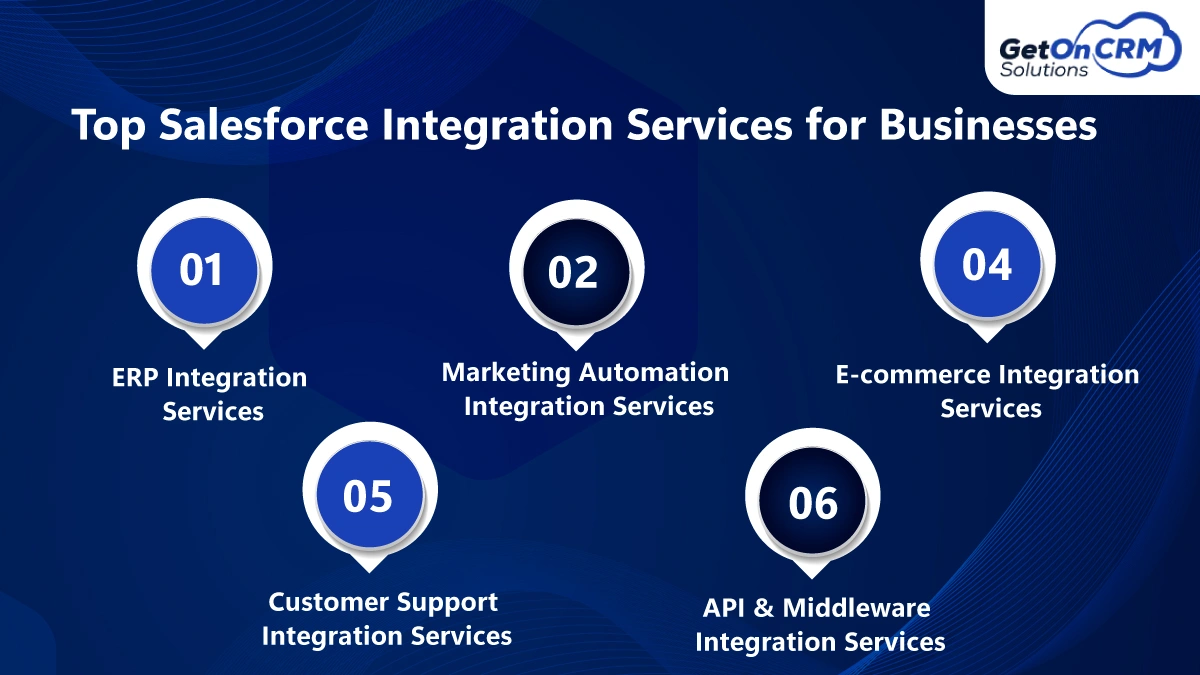
Top Salesforce Integration Services for Businesses
✦ ERP Integration Services
Data can move between customer-facing and operational company operations thanks to ERP integration, which links Salesforce with enterprise resource planning systems like SAP and Oracle ERP. Through the synchronization of records, orders, inventory, procurement, billing, and financial operations, these integrations assist organizations in maintaining consistent information across departments. Duplicate data entry and inaccurate records can lead to inefficiencies when CRM and ERP systems function separately. By enabling automated data sharing between platforms, integration helps in addressing these issues.
A centralized perspective of corporate information is provided by a well-executed ERP connection, enabling various teams to access crucial data without having to navigate between separate apps. While finance and operations teams can see client activity, sales teams can see order and inventory details.
To enable system-to-system communication, organizations frequently use middleware platforms, APIs, or custom connectors. Businesses looking for increased operational visibility, better reporting accuracy, and more effective cross-functional procedures frequently use ERP integration.
✦ Marketing Automation Integration Services
Salesforce is connected to HubSpot and Marketo through marketing automation integration, which makes it easier to share customer, lead, and campaign data. The main goal is to establish a constant data flow between the marketing and sales systems so that both teams can access and accurately record client interactions. Lead capture, audience segmentation, campaign tracking, and performance reporting are all supported by this integration.
Information gaps may arise at every stage of the customer journey when marketing platforms function independently of CRM systems. By coordinating contact information, engagement history, lead scores, and marketing data, integration helps close these gaps. Salesforce receives information from prospects’ interactions with marketing content, giving sales teams more context.
In the same way, marketing platforms can receive Salesforce customer and opportunity updates to facilitate more focused communication. Businesses utilize marketing automation connectors to increase data accuracy, optimize workflows, and better understand how marketing efforts affect company results.
✦ E-commerce Integration Services
Consistent data transmission across sales, customer management, and online storefront systems is made possible by e-commerce integration. It links Salesforce with online commerce platforms like Shopify and Magento. Customer profiles, product details, inventory levels, orders, and transaction records are usually synchronized using these interfaces. Maintaining current and accurate data across all linked systems is the aim.
Without connectivity, companies frequently handle CRM and e-commerce data independently, which can result in inconsistent customer records and inefficient operations. By automating data transfer between systems, integration lowers the need for manual changes and increases information accuracy. While sales and marketing teams obtain more information about consumer preferences and purchasing patterns, customer care teams have direct access to order histories via Salesforce.
Integrations may facilitate automatic order processing, real-time inventory updates, and customer data synchronization, depending on business needs. Organizations looking for a more integrated perspective of online sales operations and customer interactions frequently employ e-commerce integration.
✦ Customer Support Integration Services
Information may be transferred between customer care and CRM systems through customer professional Salesforce integration services. It connects Salesforce with service management platforms like Zendesk and ServiceNow. These interfaces assist businesses in keeping an exhaustive log of all client contacts, including account details, service requests, support tickets, and communication histories.
Customer data may become distributed among systems when support and CRM platforms run separately. By synchronizing records and producing a more thorough picture of consumer activity, integration resolves this problem. Customer-facing team members can evaluate service history when interacting with clients, and support agents can access account details while resolving issues.
These interfaces are frequently used by organizations to facilitate departmental collaboration, enhance information accessibility, and expedite case management procedures. By combining CRM and customer service data into linked workflows, integrated support systems can help to improve reporting consistency.
✦ API & Middleware Integration Services
API and middleware integration allow Salesforce to communicate with external apps, databases, cloud platforms, and corporate systems easily. While middleware solutions like MuleSoft assist in managing and coordinating integrations across many systems, APIs serve as communication interfaces that enable applications to share data.
Integration is becoming more and more crucial for preserving data consistency and operational effectiveness as businesses use an increasing variety of business applications. Real-time information transmission is made possible via API-based interfaces, and middleware solutions offer centralized capabilities for tracking, modifying, and controlling data flows between systems.
Numerous use cases, such as corporate system interoperability, workflow automation, application connectivity, and customer data synchronization, can be supported by these connectors. System architecture, scalability needs, security concerns, and business goals all influence the particular integration strategy. Advanced digital ecosystems are built on the foundation of API and middleware integration, which makes it possible for many technologies to work together efficiently.
Popular Salesforce Integration Methods for Modern Businesses
✦ Native Salesforce Integrations
One of the most popular ways to link Salesforce with business apps is through native Salesforce integrations. Compared to custom development projects, these connectors are quicker and simpler to build because they are made to function directly within the Salesforce ecosystem. Companies can link CRM data with marketing, customer service, productivity, and analytics platforms by utilizing AppExchange interfaces and integrated Salesforce connectors.
The reliability and convenience of maintenance of native Salesforce interfaces are among their greatest benefits. These solutions usually involve less technical work and provide a more seamless user experience because they were created especially for Salesforce. Without requiring a lot of coding, organizations may automate processes, synchronize customer data, and enhance departmental cooperation.
Native integrations offer a scalable and affordable option for companies seeking to optimize CRM productivity and streamline operations. Native integration options continue to be a popular option for businesses looking for rapid and effective connectivity between crucial business systems, as Salesforce adoption continues to rise.
✦ API-Based Integrations
Salesforce integration consulting services enable interaction with cloud platforms, business systems, and external apps via standardized interfaces thanks to API-based connectors. Organizations that need more flexibility in system interactions and real-time data exchange frequently employ this integration technique. Businesses can select the method that best suits their technical needs thanks to Salesforce’s support for both REST and SOAP API connections.
Because of their quick performance and lightweight architecture, REST APIs are frequently chosen for online and mobile applications. Conversely, SOAP APIs are frequently utilized in business settings that call for improved security measures and structured messaging.
Businesses may automate processes, synchronize customer records, and guarantee data consistency across many platforms with the use of API-based interfaces. API integrations are essential to building a cohesive digital ecosystem as businesses depend more and more on connected technologies. They promote scalable business growth and offer the flexibility required to integrate Salesforce with modern apps.
✦ Middleware Integrations
A centralized method of integrating Salesforce with many business apps and data sources is offered by middleware integrations. Middleware platforms serve as a bridge that controls communication, data translation, and process automation throughout the whole technology stack, rather than developing distinct integrations for each system. Dell Boomi Integration and MuleSoft Integration are two well-known middleware options.
By providing prebuilt interfaces, monitoring tools, and scalable design, these systems streamline complicated integration setups. While preserving data integrity across systems, businesses can integrate Salesforce with databases, marketing platforms, ERP systems, and legacy apps. Businesses using multiple applications and managing large volumes of data can benefit significantly from middleware integrations.
Middleware solutions help companies better support digital transformation initiatives by lowering integration complexity and increasing operational effectiveness. Middleware continues to be an essential part of modern Salesforce integration strategy as companies grow their technological ecosystems.
✦ Custom Integrations
In order to satisfy specific business needs that cannot be satisfied by native connections or traditional middleware solutions, custom Salesforce integrations are created. This strategy is frequently used by organizations when they require industry-specific features, specialized workflows, or integration with proprietary software. Custom API development and legacy system integration are typical examples.
You have total control over how Salesforce trades data with other systems thanks to custom connectors. Custom business logic can be defined, specialized processes can be automated, and user experiences can be customized to meet operational objectives. Custom integrations offer unparalleled flexibility and scalability, but they usually demand more planning and development work. Businesses with intricate IT infrastructures or extremely specific integration needs will find them particularly helpful.
Custom Salesforce interfaces ensure smooth data flow and increased business productivity as companies modernize their operations by bridging gaps between new digital platforms and current systems.
Also Read: Top Salesforce Consulting Company in India Trusted By Industry Experts
How to Choose the Right Salesforce Integration Partner
✤ Technical Expertise
The important aspect to consider for selecting Salesforce integration experts is technical proficiency. Connecting Salesforce to other business apps, databases, ERP systems, and cloud platforms is a common component of successful integrations. A qualified partner should be certified in Salesforce, have practical implementation expertise, and have a solid understanding of middleware and APIs.
How well they can develop, implement, and oversee integrations while guaranteeing security, scalability, and performance depends on their technical competence. Businesses may choose vendors who can handle both basic and complicated Salesforce integration requirements by evaluating prior projects, technical credentials, and integration strategies.
✤ Industry Knowledge
The success of Salesforce integration projects is greatly influenced by industry expertise. Every industry has different customer journeys, operational issues, workflows, and regulatory requirements. A salesforce integration consultant with relevant industry experience is better able to comprehend business-specific needs and suggest integration tactics that support organizational objectives.
Businesses gain from collaborating with partners who are knowledgeable about industry procedures and data flows, whether they are in the healthcare, banking, manufacturing, retail, or technology sectors. This knowledge ensures that the integration supports both present operations and future business expansion, lessens implementation difficulties, and improves system alignment.
✤ Support and Maintenance
To sustain performance over time, Salesforce integrations need constant monitoring, upgrades, and optimization. Businesses should take into account the degree of post-implementation support and maintenance services provided when assessing Salesforce integration experts. As business needs change, a dependable integration partner offers continuous technical support, problem-solving, performance monitoring, and system updates.
Continuous maintenance guarantees that integrations stay compliant with platform changes and assists in identifying possible issues before they affect operations. Long-term support is crucial when choosing an integration provider because having access to specialized support resources can also lower downtime and increase system dependability.
✤ Pricing and Transparency
When selecting a Salesforce integration consulting partner, pricing transparency is crucial. Before work starts, companies should seek out suppliers who provide precise project schedules, thorough cost analyses, and clearly specified deliverables. Organizations may better comprehend implementation costs, maintenance costs, and any additional service fees that may be incurred throughout the project lifecycle with the use of transparent pricing.
It is also simpler to compare vendors and assess overall value when a proposal is structured. Beyond cost, openness in project management and communication lowers misconceptions, helps set reasonable expectations, and facilitates a more seamless integration process from planning to implementation.

Transform Your Business with Seamless Salesforce Integrations
Salesforce is the widely chosen CRM globally, and you can unleash its potential by integrating it with your business. This Salesforce integration guide gives you a brief about its types, challenges, benefits, best practices, and ways to choose the ideal Salesforce integration partners. An ideal partner is necessary to build an operational efficiency, an enhanced user experience, and a tech stack that is future-ready.
Salesforce integration isn’t about syncing data but allowing improved decisions, faster service, and a strong relationship. Salesforce integration is crucial for enhancing business operations, data quality, and making improved choices. Consult with the Salesforce integration company to integrate a leading CRM into your existing system today.