
Many businesses thought that implementing a CRM system was as easy as purchasing the licenses and adding the users. This was not the case. Implementation extends beyond that. The seemingly easy system can grow into many things, including the redesign of most of the workflow, issues related to the movement of data, complex integrations, and the planning of optimization. Moreover, the system may require employees to undergo training on the new platform. This is the reason why the costs of Salesforce implementation differ across businesses.
For instance, a company that has a sales team of five employees does not require the same system as a company that has hundreds of employees across multiple departments. Not all companies require the same system. Some can survive with minimal systems for managing leads, while others may need a system that can provide automation of tasks, AI reporting, customer portals, a connection to ERP systems, automation systems, and support systems. Each additional customization changes the scope, the time, and the investment of the project.
Selecting the right salesforce implementation service provider affects costs and outcomes. Consultants with extensive experience develop operational systems that meet business needs instead of requiring businesses to adopt standard CRM systems, which become challenging to maintain.
CRM implementation can deliver significant long-term return on investment for businesses. Industry statistics point to an average increase of 29% in revenue and a 34% increase in the productivity of the sales function attributable to the use of a CRM system. In spite of the benefits, most organizations keep an unbalanced budget owing to inadequate consideration of the implementation challenges, like integrations, custom workflows, data scrubbing, building a test environment for the system, staff training, and the provision of support after the system goes live.
What Is Salesforce Implementation?
➥ Definition and implementation scope
Salesforce implementation involves the process of configuring, customizing, integrating, and deploying the Salesforce platform to fulfill a company’s operational requirements, customer management processes, and growth objectives. The implementation process goes beyond establishing user accounts and transferring contact information. The successful implementation process changes all aspects of team operations, including sales activities, customer communication, reporting tasks, support work, and automated business processes across the organization.
Every business has its own distinct operational processes, its customer management systems, and its business objectives; thus, Salesforce implementation needs to be customized for each organization. Some companies need basic CRM functionality, while others require automation, integrations, and advanced reporting and customer portals.
A professional Salesforce implementation service helps align the platform with actual business operations. The implementation process typically includes planning, customization, data migration, integrations, testing, employee training, and optimization. The lack of proper implementation planning results in low adoption rates and workflow inefficiencies, together with reporting issues and operational challenges that businesses experience after deployment.
➥ Key implementation stages
Business operations will reduce deployment risks through a structured implementation process, which will also improve their CRM system performance over time.
⮞ Discovery and Business Analysis
The first stage focuses on understanding the company’s goals, customer journey, operational bottlenecks, and reporting requirements. The teams analyze customer relationship management requirements to determine what sales improvements, automated customer communication, and decreased manual work processes should achieve.
⮞ Platform Configuration and Customization
The company requires Salesforce system configuration to match its operational business processes. The current phase of the project establishes all system components, which include dashboards, user roles, automation rules, custom objects, reporting structures, and approval processes. Businesses with more complex operations often work with experienced Salesforce implementation consultants to create scalable CRM environments that support future growth.
⮞ Data Migration and Integration
Customer records, sales history data, support data, and operational information are transferred from legacy systems to Salesforce. The team establishes connections to accounting software, ERP systems, marketing applications, and communication tools during this stage.
⮞ Testing and Deployment
The business tests its workflows, automations, reports, and integrations before their launch. The organization implements the CRM system enterprise-wide after finishing testing with trained staff members who receive onboarding assistance.
➥ Different types of Salesforce deployments
Salesforce deployments differ depending on business size, industry, and operational complexities.
⮞ Standard CRM Deployment
Smaller businesses rely on basic CRM functions, consisting of lead assignment, contact information, and sales.
⮞ Customized Business Deployment
Mid-sized businesses at later developmental stages require integration of workflow automation, a dashboard, and departmental customization.
⮞ Enterprise Salesforce Deployment
Large enterprises create multi-cloud systems that use advanced automation, AI tools, compliance controls and global reporting functions to operate across their various departments and worldwide locations.

Factors That Affect Salesforce Implementation Costs
➥ Business size and user count
The size of an organization directly impacts overall Salesforce implementation costs because larger teams need to acquire additional licenses, together with user permissions, workflow structures, dashboards, and onboarding support. A company with multiple departments often needs role-based access controls and advanced reporting systems.
Businesses that expand their operations to multiple locations need to implement extra integrations, automation tools, and teamwork solutions to manage their increased operational needs, which leads to higher costs for both their initial implementation and their ongoing customer relationship management system maintenance.
➥ Customization requirements
Customization Requirements Customization serves as the primary element that determines salesforce crm implementation cost because organizations maintain distinct sales and service procedures. Some companies need simple pipeline management, while others require custom objects, approval workflows, automated notifications, AI-driven reporting, and customer portals. Advanced personalization increases development time, testing requirements, and system maintenance needs, all because companies select highly customized Salesforce implementation & solutions for their operational requirements.
➥ Data migration and integrations
Migrating customer records, historical transactions, support tickets, and all operational data from legacy systems requires thorough validation and careful planning. The process of migration produces operational disruptions through the creation of duplicate records, missing data, and incorrect reporting results.
The pricing structure of a business depends on its integration needs, which require Salesforce to connect with ERP systems, accounting software, marketing tools, and communication platforms. Organizations need to use advanced technical knowledge because complex integrations demand experts who can deliver stable systems through extended operational times.
➥ Training and support needs
Employee adoption plays a major role in CRM success, which makes training and support an important implementation expense. Businesses that invest in professional onboarding programs experience improved workflow consistency and increased productivity after their systems go live.
The organization needs ongoing support to handle troubleshooting issues, perform dashboard updates, optimize workflows, and manage user accounts. Organizations partner with a reliable Salesforce implementation agency to get post-launch support, employee training, and continuous CRM optimization assistance as their business requirements change.
Also Read: Salesforce Revenue Cloud Cost: Complete Pricing Guide for Businesses
Salesforce Licensing, Platform Pricing & User Costs
❏ Salesforce editions and pricing tiers
Salesforce has many platform editions designed for businesses operating at different levels, stages of growth, and needs of customization. Smaller businesses choose the basic plans, which include standard CRM features, while larger companies have enterprise-grade requirements for automation, analytics, and security.
Companies investing in advanced Salesforce implementation & solutions choose higher-tier editions, which support more customization, more extensible integrations, and the ability to manage unique workflows for each department across large teams and large-scale business operations.
❏ Per-user license costs
Salesforce licensing operates on a monthly basis, where organizations must pay for each user who accesses the platform. The total cost of Salesforce depends on the specific user roles, selected features, chosen cloud products, and required extra functionality. Different license types are necessary for sales teams, support departments, marketing users, and administrators. The implementation of advanced permissions, automation capabilities, and premium features results in organizations needing to spend more on CRM licensing throughout the year.
❏ Hidden platform expenses
The organization incurs expenses beyond standard licensing fees because it needs to pay for storage upgrades, API usage, third-party applications, sandbox environments, advanced analytics tools, integration middleware, and premium support plans. The organization incurs ongoing operational costs through its need for custom workflow maintenance and ongoing optimization work. Unbudgeted expenses lead to higher CRM expenses, which exceed the initial implementation cost.
Average Salesforce Implementation Cost Breakdown
❏ Cost by Business Size
⮞ Small business CRM setup costs
Small businesses usually invest in basic CRM configurations, which include contact management functions, sales tracking features, and reporting dashboard capabilities. The system deployment process becomes simpler because of lower user counts and restricted customization options. The total salesforce implementation cost for businesses that plan to expand their operational teams requires assessment of integration needs, onboarding requirements, and automation setup.
⮞ Mid-sized business customization costs
Mid-sized companies need customized solutions that provide advanced workflow automation, custom reporting systems, approval workflows, and marketing and accounting platform integrations. The additional requirements lead to an increase in both development and testing activities. Companies at this stage of growth need to spend money on adaptable Salesforce implementation solutions that provide support for office-specific workflows while enabling their business to expand and develop new customer relationship management methods.
⮞ Enterprise implementation pricing
Enterprise-level Salesforce deployments involve multiple departments, large user bases, complex integrations, security controls, and advanced automation requirements. Organizations that operate globally need to have their systems support multiple languages and manage compliance requirements. The highly customized environments require extensive consulting services, testing, and optimization work, which leads to significant project expansion, longer implementation times, and increased total CRM deployment costs for large organizations.
❏ Consultant & Partner Pricing
⮞ Freelancer pricing
Freelance Salesforce professionals charge lower hourly rates, which makes them suitable for small businesses that need basic CRM systems. The hourly rates for freelancer-led CRM implementation services in 2026 start at $30 and exceed $150, while the total project expenses range from $1,000 to more than $25,000. The implementation process requires various business needs to be evaluated, which includes assessing workflow complexity, customization needs, integration requirements, reporting setup, and total implementation requirements.
⮞ Salesforce agency costs
A professional Salesforce implementation agency provides businesses with unified services that include strategic planning, technical development work, CRM system design, user onboarding, and ongoing system improvement services. In 2026, CRM implementation projects may start near $10,000 for smaller businesses and exceed $500,000 for enterprise deployments. The cost of agency-led implementations varies from $25,000 to more than $100,000 based on the depth of customization needed, the complexity of integrations with existing systems, and the necessary activities to migrate data and the objectives for future system growth.
⮞ Certified partner rates
Certified Salesforce partners charge premium rates because they provide verified expertise, structured implementation methodologies, and specialized industry knowledge. Certified consulting partners in 2026 will manage projects that typically cost between $20,000 and over $100,000 for small and mid-sized businesses. The hourly consulting rates range from $100 to $300, which depends on the project needs, which include customization, integration, automation, deployment, and future CRM assistance requirements.
❏ Ongoing Salesforce Costs
⮞ Admin support
Businesses need ongoing administrative support after deployment to handle user management, workflow changes, permission updates, report creation, and system problems. Internal admins or external consultants help maintain CRM performance as operational needs evolve. Organizations require permanent administrative support to manage their increasing data volumes, expanding workforce, and operational changes in sales, marketing, and customer service functions.
⮞ System enhancements
Organizations implement new business processes, automated systems, dashboard systems, and integration capabilities to develop their existing CRM systems, which continue to evolve after their initial launch. The system improvements enable organizations to achieve better operational performance while they maintain their ability to meet new customer demands. The process of continuous optimization raises future CRM expenses because ongoing technical expertise and structured implementation planning support will be required for development, testing, and customization work needed to deploy system updates.
⮞ Managed services
Organizations choose to invest in Salesforce managed services to achieve ongoing platform stability, secure operations, and dependable performance after their systems go live. The managed support providers perform their duties by monitoring systems, conducting updates, system optimization, troubleshooting, and workflow enhancement activities. Companies can achieve their goals of decreasing operational downtime, increasing user adoption rates, and maintaining their CRM systems for business growth through this strategy, which requires minimal in-house technical personnel.
Smart Approaches to Salesforce Implementation Planning
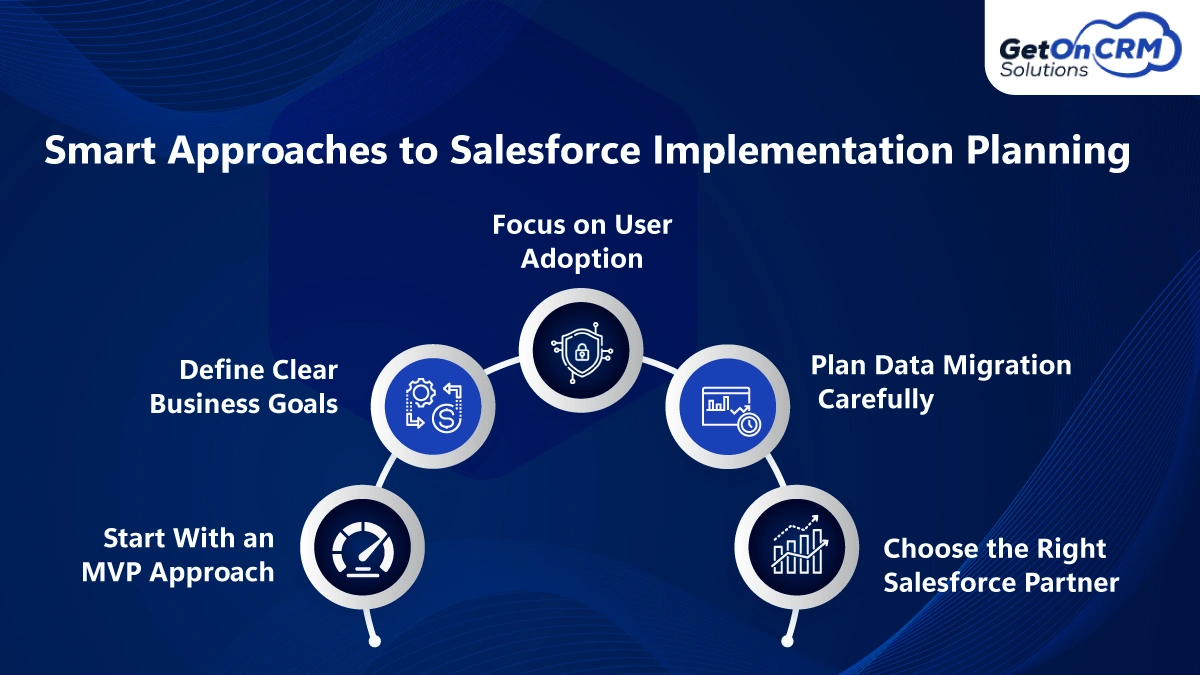
❏ Define Clear Business Goals
⮞ Business alignment
Successful CRM projects begin with clearly defined operational objectives rather than focusing only on software features. The implementation process requires businesses to first identify their existing workflow deficiencies, customer management problems, and reporting needs before they begin their project work. Organizations achieve successful implementation through strong CRM system alignment with their business objectives, which enables teams to work more efficiently and reduce operational confusion while minimizing costs during the system development process.
⮞ Measurable outcomes
Companies should establish measurable performance indicators before deployment to evaluate implementation success accurately. The metrics lead conversion rates, response times, sales productivity, and customer retention metrics provide organizations with better insights about their customer relationship management systems’ performance. A structured measurement strategy also helps organizations justify investments, optimize workflows continuously, and manage expectations related to overall Salesforce implementation price and long-term business value creation.
❏ Start With an MVP Approach
⮞ Essential features first
Businesses face implementation difficulties because their staff members attempt to install all system functions at once. The initial stage of CRM implementation requires organizations to start with basic contact management, sales tracking, reporting, and automation functions. The majority of modern Salesforce implementation solutions use a phased approach because it helps businesses to better adopt new systems while minimizing disruptions and testing their operational processes before they implement advanced features.
⮞ Gradual scalability
The process of gradual expansion enables organizations to improve their customer relationship management systems. The process requires the core functions to be mastered before organizations can begin their advanced reporting, integration, automation, and customer engagement tool implementation. The method improves financial planning because it helps companies to maintain their implementation priorities through the use of a structured salesforce implementation cost checklist.
❏ Focus on User Adoption
⮞ Employee training
The advanced CRM platform only achieves effective results when users demonstrate proper system usage skills. The platform training program uses three components, which include structured onboarding sessions, role-based training, and workflow demonstrations to help teams achieve platform mastery. Practical employee training programs that businesses implement lead to increased productivity, enhanced reporting accuracy, and improved CRM system deployment and upgrade processes.
⮞ Active system usage
The user adoption process requires employees to learn about CRM functions, which simplify their work tasks instead of creating extra administrative duties. The business needs to establish regular usage patterns through simplified workflows, leadership support, and continuous assistance with performance assessment. Salesforce implementation expert organizations help their clients achieve better user acceptance through their implementation methods, which emphasize sustainable system use and departmental productivity across their business operations.
❏ Plan Data Migration Carefully
⮞ Clean business data
The process of moving outdated records that contain incomplete information and duplicate data into Salesforce becomes operationally disruptive while creating immediate reporting errors that start after system deployment. Before migration begins, businesses should clean customer databases, standardize information formats, remove duplicate entries, and validate historical records carefully. High-quality data establishes a foundation that enhances automation accuracy, improves customer communication, reporting reliability, and total CRM performance from the start of implementation.
⮞ Reduce migration errors
Migration errors disrupt sales operations, customer service processes, and reporting accuracy because they happen after the system goes live. Businesses should conduct staged testing, backup validations, and sample data checks before moving complete datasets into Salesforce. The organization requires migration planning because it prevents data loss, workflow failures, duplicate entry problems, and integration conflicts while maintaining business operations during the transition period.
❏ Choose the Right Salesforce Partner
⮞ Certifications & expertise
The choice of an appropriate implementation partner determines how well a project will function and expand its capacity while sustaining its CRM system throughout its operational life. Businesses should evaluate technical certifications, industry specialization, integration capabilities, and strategic consulting experience before making decisions. Experienced providers offering professional CRM implementation services can identify operational challenges early, recommend scalable solutions, and reduce costly implementation mistakes during complex deployment projects and optimization stages effectively.
⮞ Implementation experience
Implementation Experience Implementation experience becomes especially important when organizations require custom workflows, advanced automation, and large-scale integrations. The consultants who possess experience in multiple industries can identify deployment risks, testing needs, migration obstacles, and user adoption difficulties. Their practical knowledge helps businesses accelerate implementation timelines through CRM scalability enhancements, technical issue reductions, and system development that matches operational goals and future business growth strategies.
Salesforce ROI, Business Value & Growth Benefits
❏ Improved sales productivity
Salesforce enhances sales productivity through its customer data management platform, which enables automated follow-up processes and streamlines pipeline tracking, resulting in quicker deal closures while decreasing both operational downtime and manual task repetitions.
❏ Better customer management
The combination of unified communication tracking and customized customer interactions, rapid customer support solutions enables businesses to enhance their customer relationship management capabilities, which results in improved customer trust, increased retention rates, and enduring business partnerships.
❏ Automation and efficiency gains
Organizations use workflow automation to streamline their approval and reporting processes, their lead distribution and customer communication operations, which helps them reduce administrative work while their sales, marketing, and service departments achieve better operational efficiency.
❏ Measuring CRM ROI
Businesses evaluate CRM success through revenue growth, productivity improvements, customer retention, and decreased operational inefficiencies. The organization uses outcome monitoring to demonstrate the total salesforce implementation partners cost through measurable business value, which will continue to generate revenue over time.
Also Read: Revenue Cloud for Manufacturing: A Complete Implementation Guide
How to Reduce Salesforce Implementation Costs
❏ Use native Salesforce features
Businesses should select built-in Salesforce features because this choice enables them to achieve lower development costs while obtaining easier system upkeep, better platform reliability, and speedier system implementation without losing crucial CRM features and their business operational needs.
❏ Prioritize high-impact customizations
Businesses should focus only on customizations that improve productivity, reporting, automation, or customer experience directly. The organization should focus on essential functions that bring maximum value to its operations because this strategy helps it avoid excess development expenses while simplifying its future system upkeep tasks.
❏ Train internal admins
Internal Salesforce administrator training decreases the need for external consultants because internal staff can manage routine updates, reporting, and workflow changes, as well as user management tasks. This training program enables companies to reduce their ongoing support costs while maintaining operational flexibility.
❏ Implement in phases
Phased implementation enables companies to first deploy essential CRM features, which leads to lower initial costs, reduced business interruptions, higher employee acceptance, and improved financial oversight during the entire implementation process.
Ready to Maximize Salesforce ROI and Business Growth?
Salesforce investments provide businesses with better operational efficiency, customer visibility, automated processes, and improved sales productivity when they execute Salesforce implementation projects through precise alignment of their business objectives with their growth targets.
Strategic planning enables organizations to handle complex implementation processes while their teams achieve higher adoption success rates and their organizations learn to use successful features that they will develop into CRM systems that will support their future business growth.
An experienced Salesforce implementation agency assists businesses with risk reduction, custom solution development, accelerated deployment, and improved CRM performance throughout their system’s entire life cycle.
Businesses should prioritize scalability, employee training, phased deployment, and continuous optimization to maximize Salesforce value while improving operational efficiency and customer relationship management long-term.