
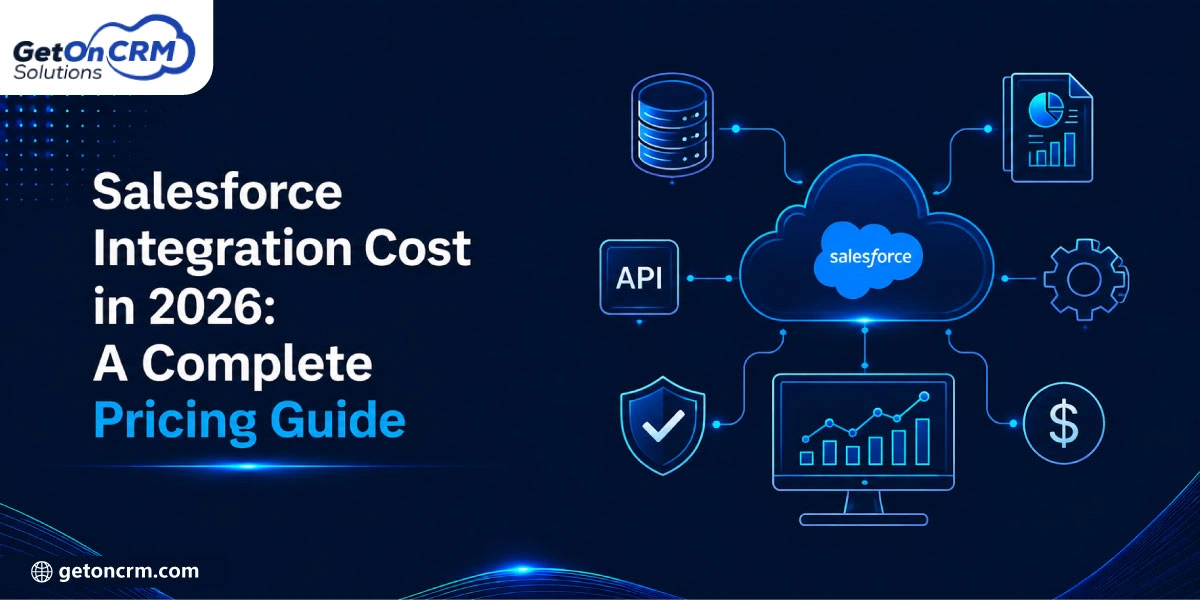
Most businesses adopt CRM to obtain instant results. However, they fail when data is distributed, and the process breaks. This is when understanding the cost of Salesforce integration services becomes necessary. Salesforce integration connects CRM with external tools, featured APIs and pre-built apps. Organizations invest in them for unifying their data, automating business operations and enhancing their customer services. Based on Salesforce research, organizations that adopt a CRM system can drive sales by 29% and productivity by 34%. Its improved pipeline visibility and unified data made salesforce a widely adopted system in the tech world.
Salesforce integration costs in 2026 vary depending on the factors like business size, number of systems being connected, involved challenges, data volumes and integrations required. Basic integration for small businesses cost significantly less than complex integrations. The enterprise-wide salesforce integration includes various apps and advanced workflows. Most leaders expect the integration cost to be limited to the subscription fee only. However, the cost involves migration, planning, integration, training, and support. The estimated cost can fluctuate based on the complexity, business size, and goals. To measure the main factors that fluctuates, Salesforce integration costs in 2026 are described in the following blog.
What Is Salesforce Integration?
⮞ Definition of Salesforce Integration
Salesforce is the backbone of your business system, but when it is implemented poorly, it can become an expensive database. Salesforce CRM integration is the method of setting & customizing the platform to fit your firm’s requirements. Salesforce integration services have become a go-to platform for user management. From startups to global enterprises, firms can rely on it for managing sales and operations.
Salesforce integration includes mapping out sales cycles, migrating old customer data, and promoting automation to save your team from hours of manual work. The process ensures the marketing interactions are captured & tracked. It enables the team to see how a deal is closed from the first click.
⮞ Why Businesses Need Salesforce Integrations?
When businesses hire a Salesforce integration company, they will ensure that their legacy data is cleaned & mapped accurately before it enters the new system. The professional integration focuses on areas that evaluate whether your CRM actually works for your firm. These key elements are process alignment, scalability, and data integrity.
A report revealed that CRM integration delivers an average of $8.71 for every $1 invested. With Salesforce integration solutions, businesses can streamline their sales pipeline, support processes, and customer journeys. Organizations that want to connect their marketing, sales,IT teams to get a centralized view of customer data can use this.
⮞ Common Systems Integrated with Salesforce
⮩ ERP systems
Salesforce integration with ERP allows seamless data sharing between finance, sales, inventory, and supply chain operations. The integration enhances order management, financial reporting, inventory visibility, and customer service while stopping manual data entries. The firm can gain real-time metrics, streamline operations, and enhance decision-making across various departments through a unified ecosystem.
⮩ Marketing automation platforms
Salesforce integrates with automation platforms to synchronize user data, campaign performance, and email marketing activities. The integration supports sales & marketing teams working together effectively by offering a complete customer view. Organizations can automate leads, customize campaigns, and enhance conversion rate and ROI.
⮩ Accounting software
Integrating Salesforce with accounting software automates the exchange of invoices, user records, payments, and financial transactions. This integration limits manual activities, reduces data errors, and accelerates billing operations. Finance and sales teams obtain real-time visibility into payment status, revenue, and user accounts. It enhances operational efficiency and financial accuracy.
⮩ E-commerce platforms
Salesforce integration with retail platforms synchronizes product catalogs, user data, inventory levels, and order details. It allows firms to deliver customized shopping experiences while managing accurate stock management and sales records. Real-time data sharing enhances order fulfillment, user engagement, and overall virtual shopping performance across various sales channels.
⮩ Customer support software
Integration of Salesforce with customer support offers a unified system of customer interactions, history, and support tickets. The integration enhances response time, user satisfaction, and solves errors faster, automating case management. It ensures consistent communication across sales & support teams.
⮩ Payment gateways
Salesforce integration with payment gateways allows secure payment processing directly within business workflows. Businesses can benefit from this in terms of faster payment collection, improved user experience, enhanced security, and streamlined revenue management.
⮩ Custom applications
Multiple firms integrate Salesforce with custom apps designed for unique operational demands. These Salesforce integration cost estimates allow easy data transfer, automated operations, and secure communication. The integration allows improved productivity, supports firm processes, and enhances user experience.
Also Read: Salesforce Integration Services Explained: Everything You Need to Know
Salesforce Integration Tools and Their Costs.
◈ Native Salesforce Integrations
Native Salesforce integrations eliminate the need for complicated development by connecting Salesforce with frequently used applications. While advanced features might necessitate additional subscriptions, many of these integrations are covered by current Salesforce licenses. They provide seamless compatibility, enhanced security, reduced maintenance costs, and quicker implementation. They are a great option for companies looking for dependable, affordable integration solutions because of these features.
◈ Middleware Platforms
Salesforce can communicate with a variety of business apps, databases, and legacy systems thanks to middleware platforms, which serve as an intermediary layer. These platforms simplify data synchronization, workflow automation, and system monitoring while lowering the need for custom coding. Subscription plans, connector availability, transaction volume, and deployment complexity are usually factors that affect costs. For companies that manage a variety of software environments and need scalable, centralized integration management across business operations, middleware solutions are perfect.
◈ iPaaS Solutions
Using pre-made connectors, APIs, and automation tools, this solution offers cloud-based platforms that link Salesforce with hundreds of third-party apps. The quantity of integrations, workflows, users, or data transactions handled each month typically determines pricing. iPaaS solutions offer centralized monitoring, enhance scalability, speed up deployment, and make maintenance easier. They are a favored choice for expanding companies with changing integration needs because of the following features.
◈ Custom API Integrations
In order to address specific business processes that are not supported by pre-built integration tools or standard connectors, custom API integrations are created. System complexity, API accessibility, security needs, testing efforts, and ongoing maintenance all affect development costs. More flexibility, improved performance, total control over data exchange, and smooth compatibility with specialized business applications and workflows are all benefits of custom integrations.
◈ Choosing the Right Integration Tool
Your company’s budget, current technology stack, future scalability needs, and business objectives all play a role in selecting the best Salesforce integration tool. Custom API integrations are often advantageous for businesses with specialized workflows. The best integration strategy is ensured by assessing implementation costs, maintenance, security, flexibility, and long-term ROI.
What Influences Salesforce Integration Cost in 2026?
⮞ Number of Systems Being Connected
The more business apps you integrate with Salesforce, the higher the implementation cost you have to pay. Integrating CRMs, ERPs, accounting, and marketing software demands additional configuration, QA, and maintenance. Selecting scalable Salesforce integration solutions helps to manage various connections efficiently while supporting future business growth.
⮞ Integration Complexity
Integration costs rise when workflows involve real-time synchronization, complicated business logic, various APIs, and legacy systems. Projects demand custom mapping and advanced automation, requiring better technical expertise, longer development timelines, and more comprehensive QA before release.
⮞ Custom Development Requirements
Organizations with unique operations often demand custom APIs, middleware configuration, and Salesforce components. These tailored developments raise Salesforce integration pricing. However, it ensures the integration aligns with specific operational demands and supports long-term scalability.
⮞ Data Volume
Large volumes of historical & real-time data demand careful migration, validation, and synchronization. High data volumes require improved infrastructure, optimized integration, and extended QA to manage performance, limit downtime, and ensure safe data transfer.
⮞ Integration Method
The integration approach directly impacts project cost. Native Salesforce connectors are basically affordable, while middleware platforms require additional licensing, development, and maintenance. The ideal approach demands additional licensing and maintenance.
⮞ Security & Compliance Requirements
Industries with strict regulatory demands often demand advanced security measures. Encryption, RBA, and compliance standards uplift implementation challenges, QA efforts, and integration costs.
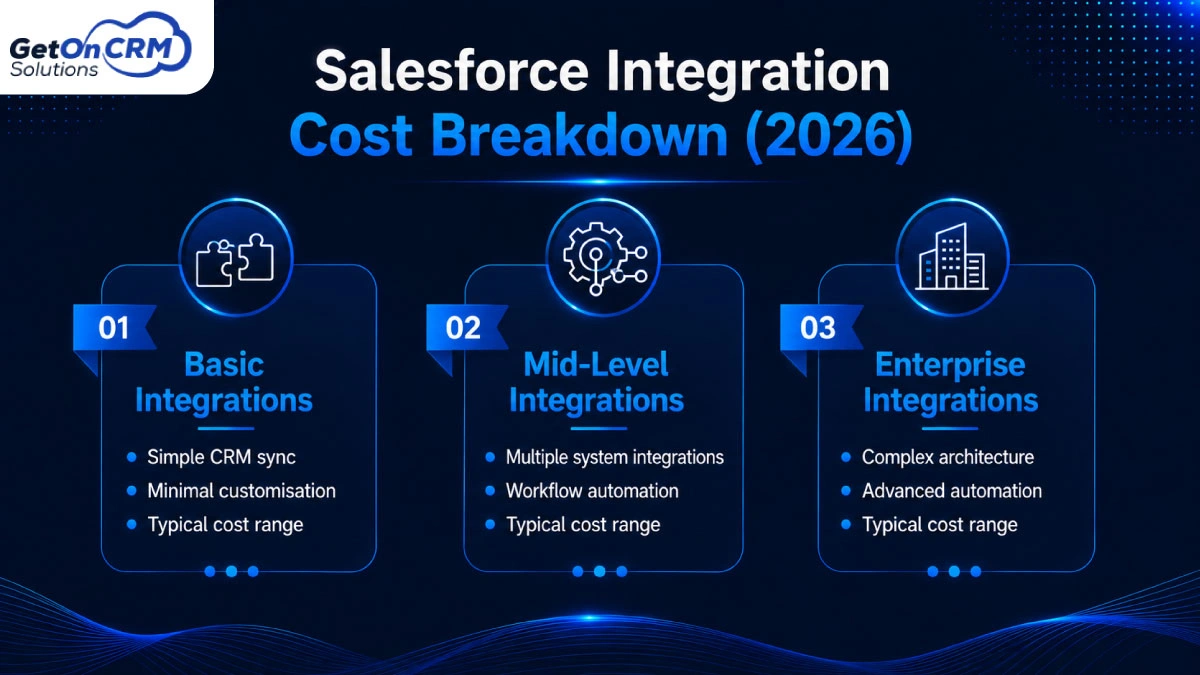
Salesforce Integration Cost Breakdown (2026)
◈ Basic Integrations
Few firms that seek to integrate Salesforce with one or two applications can benefit from basic Salesforce integrations. These projects use standard API configurations, minimal customization, and straightforward CRM synchronization. The typical cost is between $3,000 and $10,000, depending on the integration platform and project requirements, and implementation is typically finished in a few weeks.
◈ Mid-Level Integrations
Several business systems are connected by mid-level Salesforce integrations. They frequently consist of secure API integrations, data transformation, custom field mapping, and workflow automation. Depending on integration complexity, business procedures, and customization needs, Salesforce integration agency charges between $10,000 and $40,000. They also require more planning and testing.
◈ Enterprise Integrations
Enterprise Salesforce integrations are made for big businesses that need to process large amounts of data and have sophisticated IT ecosystems. Advanced automation, unique middleware, numerous APIs, real-time synchronization, strong security, and compliance measures are covered by this. Depending on the complexity of the architecture, the number of connected systems, and the need for continuous support, these large-scale implementations usually cost between $40,000 and $150,000 or more.
Salesforce Integration Costs by Integration Type
⮞ Salesforce + ERP
Real-time synchronization of customer, inventory, finance, and order data is made possible by integrating Salesforce with ERP systems. Projects usually cost between $15,000 and $100,000+, depending on business size and customization, because of complicated workflows and data mapping.
⮞ Salesforce + Marketing Automation
Lead management, campaign tracking, and customer engagement are streamlined when Salesforce is integrated with marketing automation platforms. Depending on the complexity of data synchronization, custom workflows, and automation requirements, these integrations typically cost between $5,000 and $25,000.
⮞ Salesforce + E-commerce
Products, customers, orders, and inventory are synchronized when Salesforce is integrated with e-commerce platforms. Depending on platform complexity, payment integration, and real-time inventory management needs, costs typically fall between $8,000 and $40,000.
⮞ Salesforce + Accounting Software
Financial reporting, invoicing, and payment tracking can all be automated by integrating Salesforce with accounting programs like QuickBooks, Xero, or NetSuite. Depending on the volume of transactions, unique financial workflows, and reporting needs, typical implementation costs fall between $5,000 and $20,000.
⮞ Salesforce + Customer Support Platforms
Centralizing customer interactions, support tickets, and case management is achieved by integrating Salesforce with customer support platforms. Depending on automation requirements, data migration, and omnichannel support capabilities, these integrations usually require a Salesforce integration budget between $7,000 and $30,000.
⮞ Salesforce + Payment Gateways
Secure payment processing, subscription billing, and transaction tracking are made possible by Salesforce payment gateway integrations with Stripe and PayPal. Depending on payment workflows, compliance needs, and custom API development, costs typically fall between $5,000 and $25,000.
How to Estimate Your Salesforce Integration Budget
◈ Business Assessment Checklist
Before estimating integration costs, determine the number of apps that need to connect with Salesforce, expected data volumes, necessary custom workflows, and safety and compliance requirements. It is recommended to evaluate the project timeline and available internal resources. Collaborating with skilled Salesforce integration experts helps track potential challenges, limit implementation challenges, and determine accurate project costs.
◈ Sample Budget Examples
A small firm integrating Salesforce with more than 2 apps may cost $3,000–$10,000. A mid-size business connecting RP, CRM, and marketing platforms with automated operations should expect $10,000–$40,000. An enterprise firm that demands various integrations, advanced automation, custom APIs, and high security can expect a budget of $40,000–$150,000+. At the end, it all depends on the project complexity, scalability demands, and ongoing maintenance needs.
Also Read: Best Salesforce Integration Tools for AI-Driven Business Automation
Common Mistakes That Increase Integration Costs
⮞ Underestimating project scope
Multiple businesses underestimate the resources, time, and tech efforts required for Salesforce integration. Overlooking system dependencies, data migration, and custom operations often leads to project delays. It can cause unexpected development tasks and increase the cost of integration.
⮞ Poor data quality
Integration of duplicate, inaccurate data creates significant complexities during implementation. Poor data quality demands extensive validation, cleansing, and mapping prior to integration. This additional effort impacts project timelines, system performance, and effectiveness.
⮞ Choosing the wrong integration tool
Choosing an integration platform that doesn’t match the company’s needs can increase costs through unnecessary licensing, limit functionality, or require expensive custom development. Determine scalability, security, compatibility, and business demands to ensure you invest in suitable integration solutions.
⮞ Lack of stakeholder involvement
When business users, IT teams, and decision-makers aren’t involved throughout the integration process, project demands can become unclear. Poor communication results in rework, delays approvals, and additional development, high implementation costs that impact overall project success.
⮞ Ignoring future scalability
Developing integration for current demands may cause expensive limitations as your firm grows. The scalable architecture accommodates additional users, apps, and data without requiring major redevelopment, assisting firms in avoiding significant upgrades.
⮞ Skipping testing
Avoiding QA can save time but can cause failed integration after release. Comprehensive Salesforce integration experts identify data inconsistencies, operational mistakes, API errors, and security errors before launch. It prevents costly fixes, business disruption, and user dissatisfaction after the system goes live.
⮞ Not budgeting for maintenance
Salesforce integration consultant requires ongoing tracking, security, updates, and compatibility adjustments as the connected app evolves. Failing to allocate a maintenance budget can result in unexpected expenses, system errors, and performance issues that become more expensive to resolve later.
Ready to Estimate Your Salesforce Integration Costs?
The budget for Salesforce integration depends on multiple factors described above. Partnering with experts helps with a tailored Salesforce integration price and a seamless release. This cost includes setup, personalization, integration, training, and support.
Successful Salesforce integration starts with a clear brief of project requirements and choosing the suitable approach based on budget and scope. Collaborating with a certified Salesforce integration company helps you come up with a confident mindset. Choose an integration option that balances cost, functionality, and scalability. Partner with an expert for tailored cost estimation and seamless release of your next project.